Self Critique on Assignment 3

Self assessment and criticism is an area I find particularly difficult. This is probably not because I am over confident, but because I tend to be very negative about my own work. This makes it difficult to write down the thoughts and also difficult to be objective.

Assessment criteria points

Demonstration of technical and visual skills – Materials, techniques, observational
skills, visual awareness, design and compositional skills. (40%)
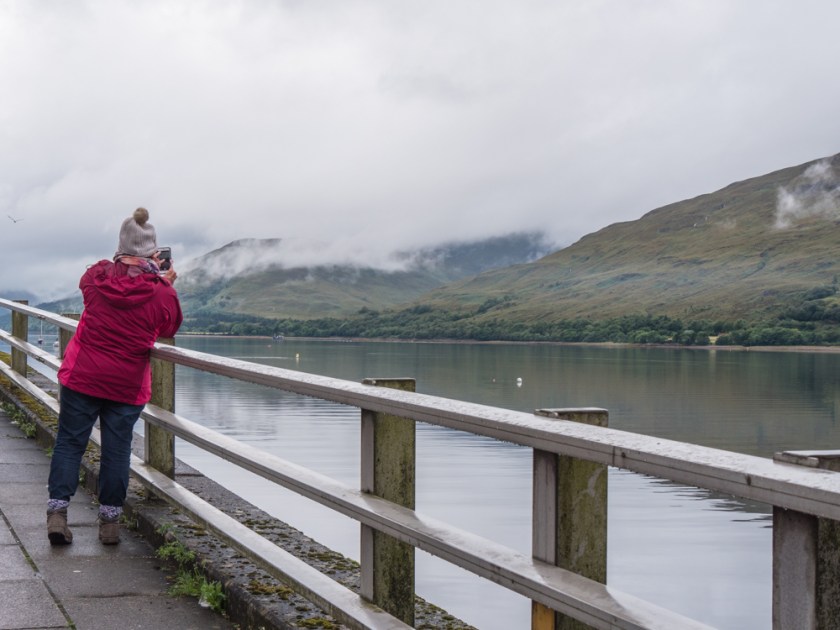
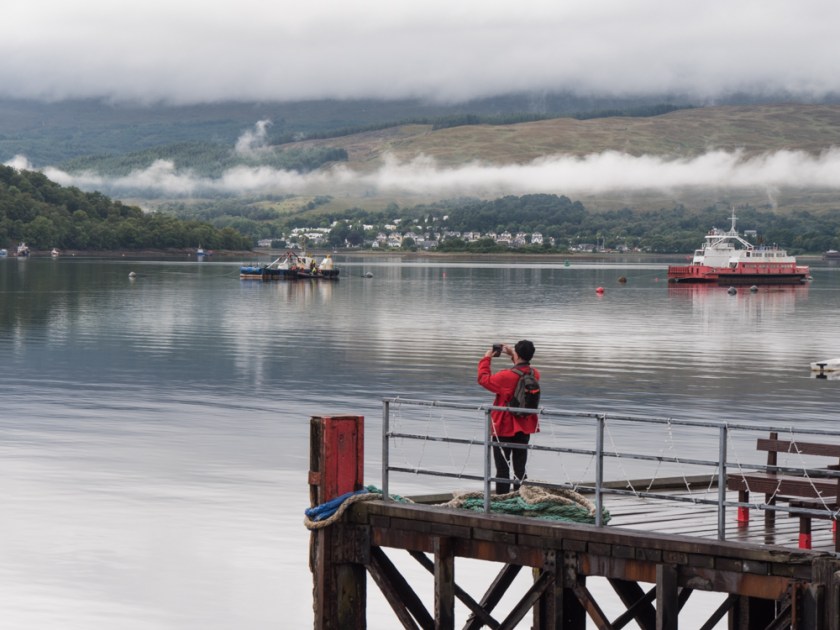
I think I produced reasonable images for this assignment. I found it hard to keep to the topic, and, because it was a specific idea, some of the images , especially those that didn’t make the final cut, had major flaws, such as depth of field or focus. I was concentrating on what was happening and didn’t always remember to think about the practical issues such as the best camera settings. It would have been helpful to think in advance about the best way to show them, for example, would it be best to have the whole image in focus, or better to just focus on the person taking the image and have the background (their subject) out of focus. I made a considered decision to only have the person on the side of the image and to show the background as a large part as I felt it made the concept more ‘real’.

Quality of outcome – Content, application of knowledge , presentation of work in a
coherent manner, discernment, conceptualisation of thoughts, communication of
ideas. (20%)
Having got the spark of an idea for this I feel I thought it through, weighing up the possibilities, and logically explaining my thought processes. This was easier to present on-line with the additional images that showed the progression of thoughts. Next time it might be better to add these images into the printed explanatory essay as will as the final chosen images. I feel that I communicated my concept in both the descriptive essay and the images.

Creativity — Imagination, experimentation, invention. (20%)
I experimented with several possibilities for this assignment before settling in the final one. I also experimented with colour versus monochrome. It’s is difficult to see how imagination comes into this – unless it is about imagining the concept in the first place. This was a ‘sideways’ take on the concept of the decisive moment – thinking about other peoples moment and trying to put myself into their place. It has made me think of several other pieces of work that would be interesting to do as a follow up including the work on selfies and possibly asking other people why they were interested in that place/photography at that time (also – what they did with their images ?post them on line,?print them or what. This would open up the possibility of contrasting their thoughts with mine.

Context – Reflection, research, critical thinking. (20%)
My research on this assignment was too limited. It was about the concept of selfies and how they were used – but then I moved away from this as an idea. I am sure there have been other studies on my eventual idea but I am not aware of them, and not sure how/where to access them.


Assignment 3

Brief: A series of 6 – 8 photographic prints on the theme of the ‘decisive moment’, which may support the tradition or question the concept.

Thought Process.

After thinking about the decisive moment at length, watching the film on Henri Cartier-Bresson and reading around the subject I spent some considerable time trying to decide how to approach this assignment.

https://scottishzoe.blog/2017/07/27/lamore-de-court-just-plain-love

https://scottishzoe.blog/2017/08/05/the-decisive-moment-or-not

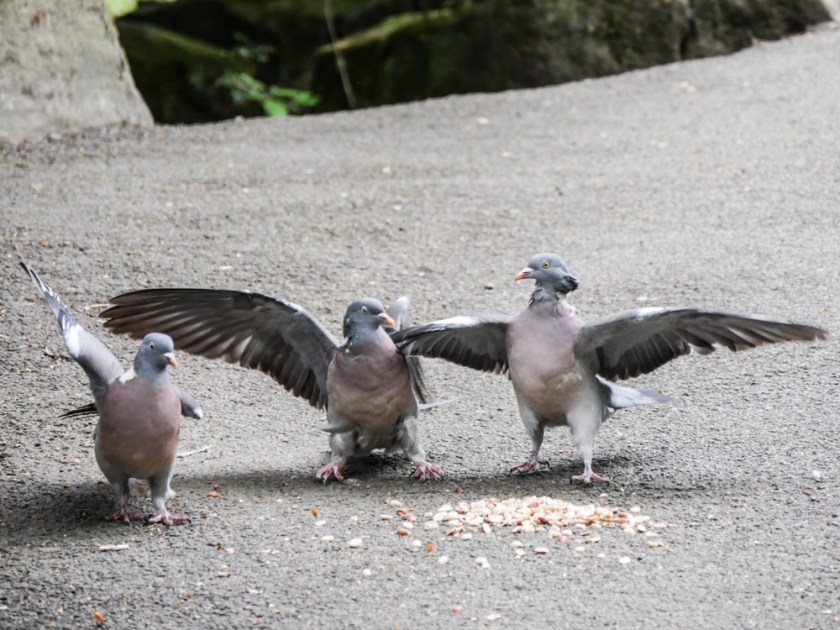
I initially thought about following the concept directly and trying some ‘traditional’ street photography but decided against this, partly because I felt that I risked simply ‘copying’ many of the images already out in this domain, and partly because I felt that I would struggle to find a linking concept. I then thought about taking a series of images of animals and birds when they were at a ‘decisive ‘point, and did start to follow this idea with some fairly interesting (or at least amusing) images of animals in the park.

untitled-74
Pigeons Arguing

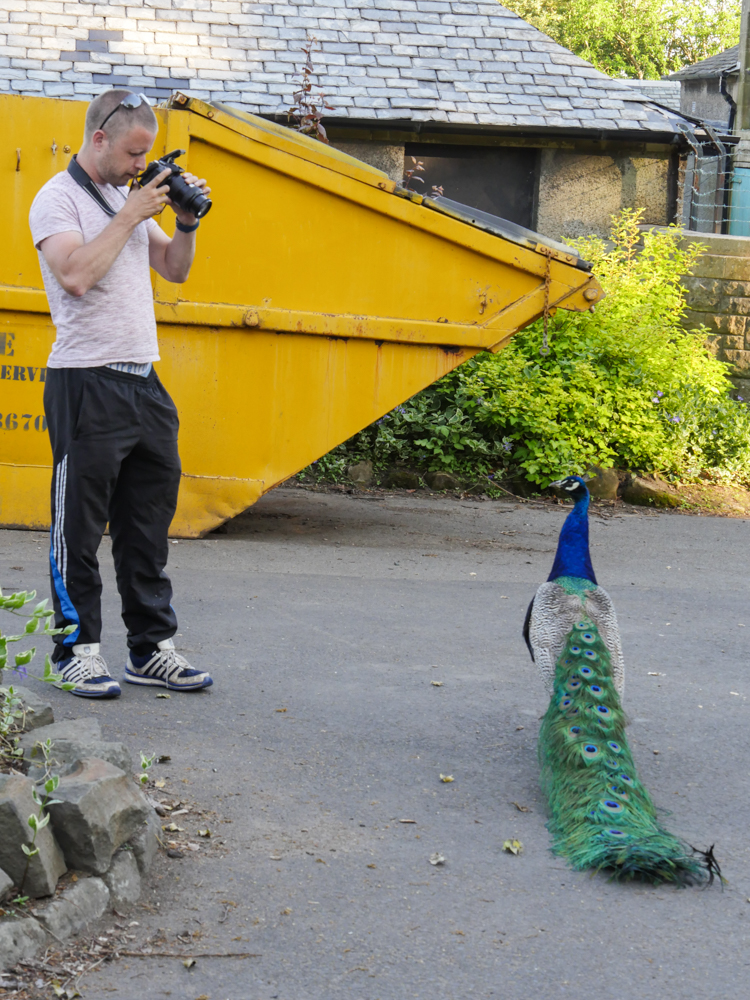
While taking these, I took an image, and realised that it was more about the person taking the photograph of the peacock than of the peacock itself, especially as it was not obliging by showing its fan. I felt this was an interesting idea as what I was doing was looking at what other people were finding to photograph – their ‘decisive moment’.

untitled-73
The Man or the Peacock?

Research.

There has been a considerable of interest in people taking photographs recently, but this has been mainly about the incredible incidence of ‘selfies’ taken and posted on social media.  A recent statistic quoted in Amateur Photographer suggested that 48% of all photographs taken by 18 to 30-year olds now are selfies (Amateur Photographer, 2017). I am not sure how that statistic was derived, but certainly, if you are watching people on the street self -portraiture appears to be the main subject, and there are clearly an enormous number of such images posted to social media.

In 2013 the Oxford Dictionaries chose ‘selfie’ as their Word of the Year. Oxford University Press then gathered a variety of scholarly reflections on this (OUP blog, 2013). In this article Lynn Schofield Clark from the University of Denver said, ‘Selfies like this are about awareness of our own self-awareness’, Karen Dill-Shackleford said A recent trip to Stonehenge had me cringing as I watched visitors to the site posing for selfies in self-absorbed abandon beside the ancient monument. Did they feel that the intriguing thing about Stonehenge was their own presence there?’ and Robert Arkin said, ‘The selfie (an arm’s length close-up self-portrait) photograph is a way to control others’ images of us, to get out in front of their judgments, to put an image in their heads with purpose and spunk. Others’ judgments are no longer just their own creation, the selfie objectifies the self, influences others’ thoughts. And, since the selfie is one’s own creation, it also affords plausible deniability; it isn’t me, it’s just one ‘me’ that I created for you’.

Cindy Sherman has recently unlocked her Instagram account and shared several ‘selfies’ although these have a particular Sherman twist in that they are distorted. (Sherman, 2017) Farago comments ‘they also point to the gap between Ms. Sherman’s vital, unsettling practice of sideways self-portraiture and the narcissistic practice of selfie snapping’ (Farago, 2017). Clearly the whole field of taking selfies, while it has much in common with all self-portraiture, could be explored at length, both academically and practically, using a combination of my own ‘selfies’ and pictures of others taking images of themselves.

Planning.

I thought about taking photographs of people taking ‘selfies’ and experimented with this, but decided not to explore this further for this assignment as it is possibly a study on the ‘indecisive’ moment rather than the decisive one when the number of selfies taken by any one person is considered. However, this would be an interesting concept to follow up in the future.

untitled-75
Who am I?

My next idea was to take relatively close-up images of the people taking photographs and pair them with images I took of the same subject immediately afterwards. I discarded this approach as the limited number of images asked for in this case would only have allowed for a maximum of four pairs, again this is an idea that it would be worth looking at in the future.

What was done.

For this series of images, I concentrated on photographs of people taking photographs, not of themselves, but of the world around them. There is a wide variety of situations shown as, although I had enough images in various locations to have concentrated on one of these, such as Kew Botanic Gardens or the Yorkshire Military Experience, I felt the overall theme was better served by diversity, although, the simple fact that I was also there, in that place and at that time, has limited the range to situations that I was also interested in.

All images were taken outside, in daylight and by natural light. I did not use a tripod or any fill flash as I did not want the subject to be aware of any intrusion into their world and none of the images were staged. There were several occasions when the person put their camera or phone down or moved away at the critical moment. I considered limiting the selection to either images taken when the other person was using a camera or when using a phone, but decided against this. The final series of images was taken over several weeks during my summer holidays. As several of these were taken in Scotland, the weather, and therefore the quality of the light, was very variable. The images were in both portrait and landscape format, but I limited the selection to all landscape to support the idea of a series.

The next question to be resolved was how to show the images. I thought about both colour and monochrome and ended up converting all the images to monochrome for comparison, and printing some of each. The monochrome conversion was performed in Silver Efex Pro2, and, unlike my normal monochrome pictures, I used a relatively high key conversion using the same settings for all the images to maintain coherence.

untitled-76
A Wet Day in the Mountains

I eventually decided on keeping to the original colour images as I felt it is likely that the ‘original’ photographs I was basing my images on would be viewed in colour, and therefore colour was truer to the concept of recording the other photographers interests and themes. Clarke says about colour images ‘Colour photographs remain problematic. They are central to the snapshot, but are still invariably rejected by the professional and art photographer who will use colour only in a deliberate and self-conscious way: either to draw attention to the medium, or to imply a statement about the subject’. (Clarke, 1997). In this case I am using colour in the latter sense. The actual image selection was also influenced by the choice of colour as the most effective images in colour were not the same as the most effective ones in monochrome.

The photographs were printed on Perma Jet Oyster paper via a Canon printer.

Final Images:

s

untitled-78
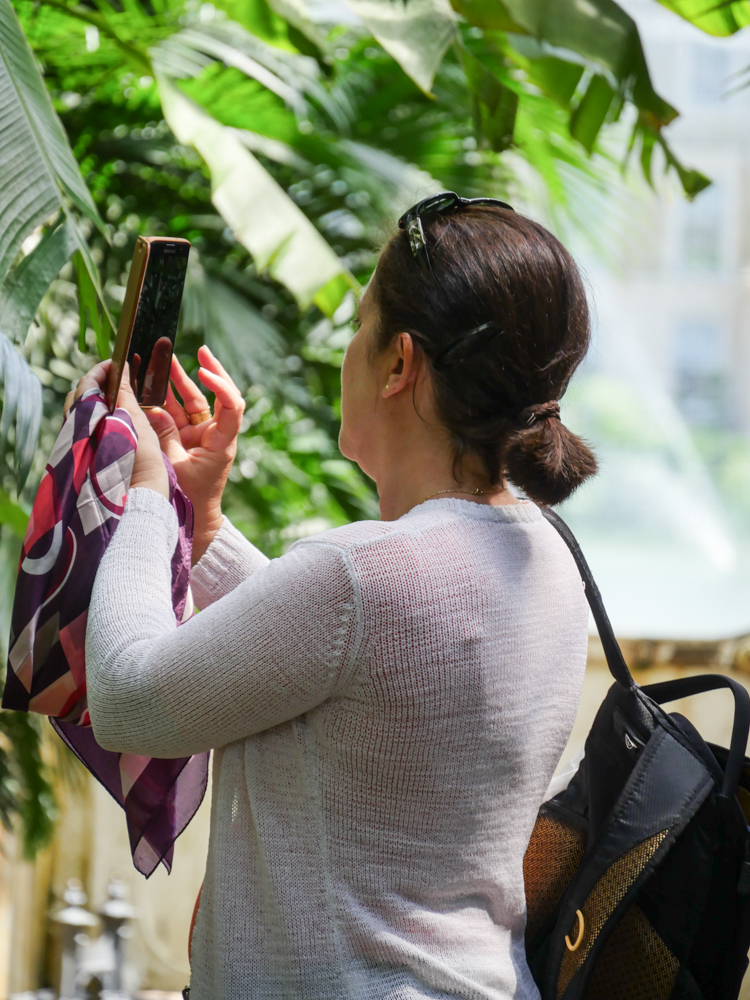
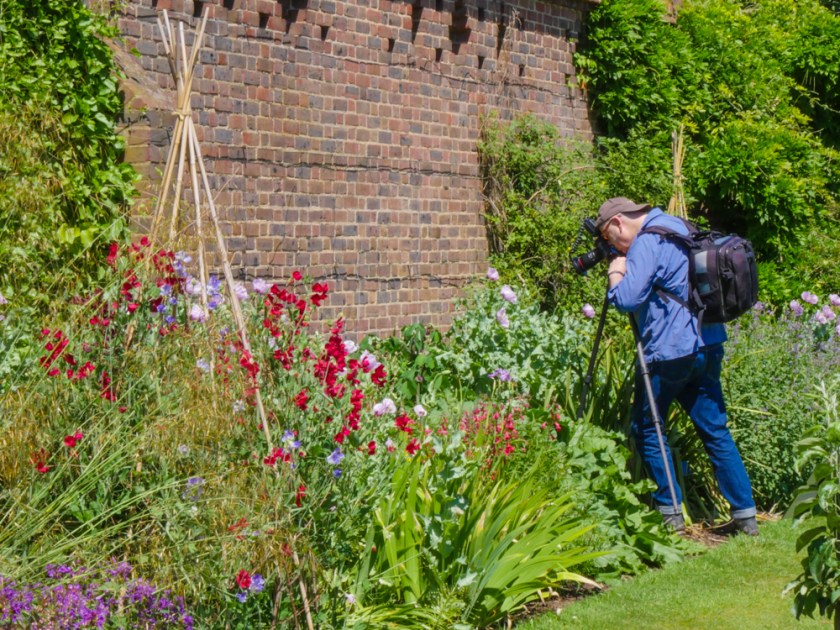
Kew Botanic Gardens – Photographing Flowers
untitled-77
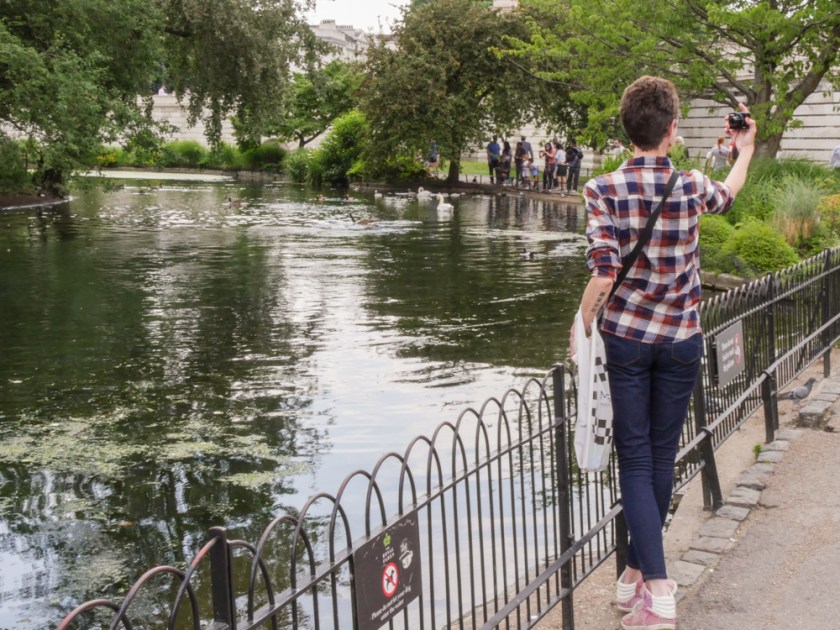
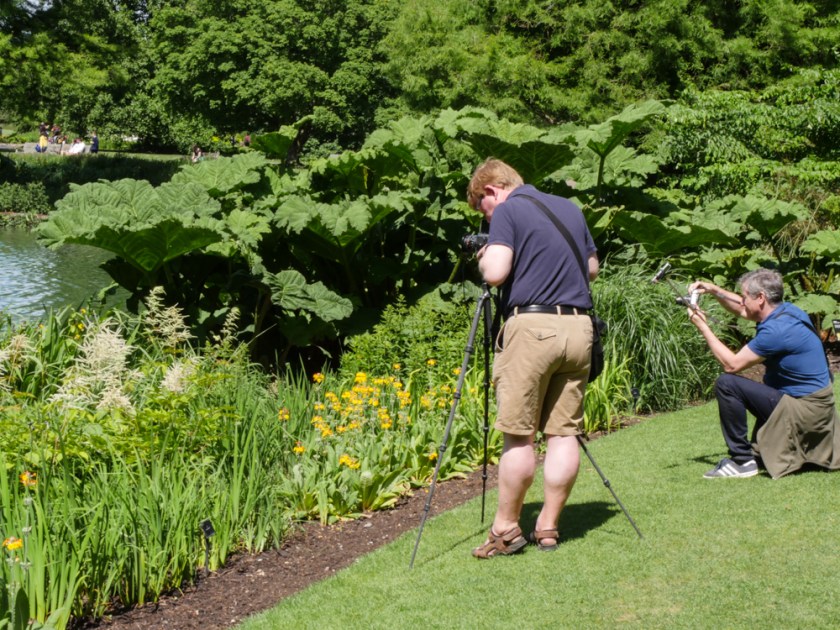
Kew Botanic Gardens – Two photographers at the Lake
untitled-80
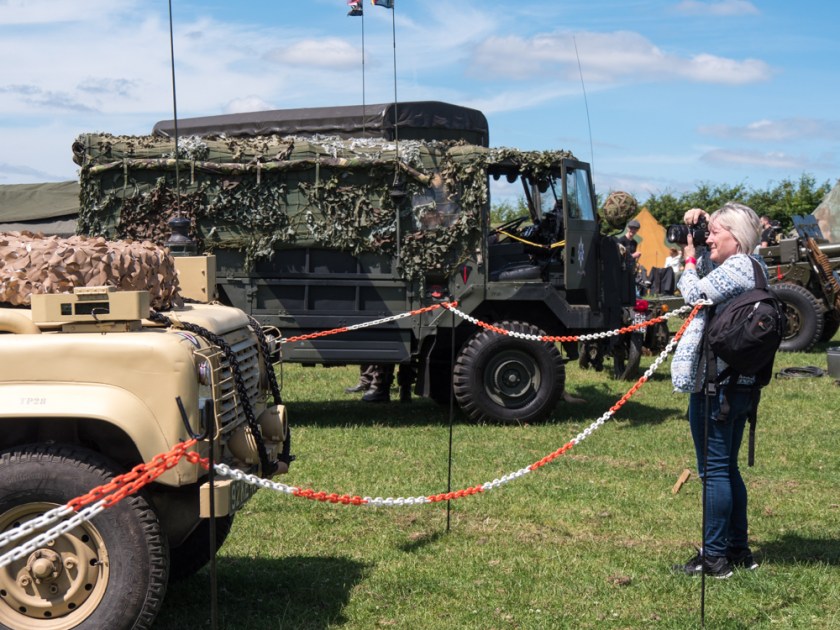
Yorkshire Military Experience – Photographing vehicles
untitled-81
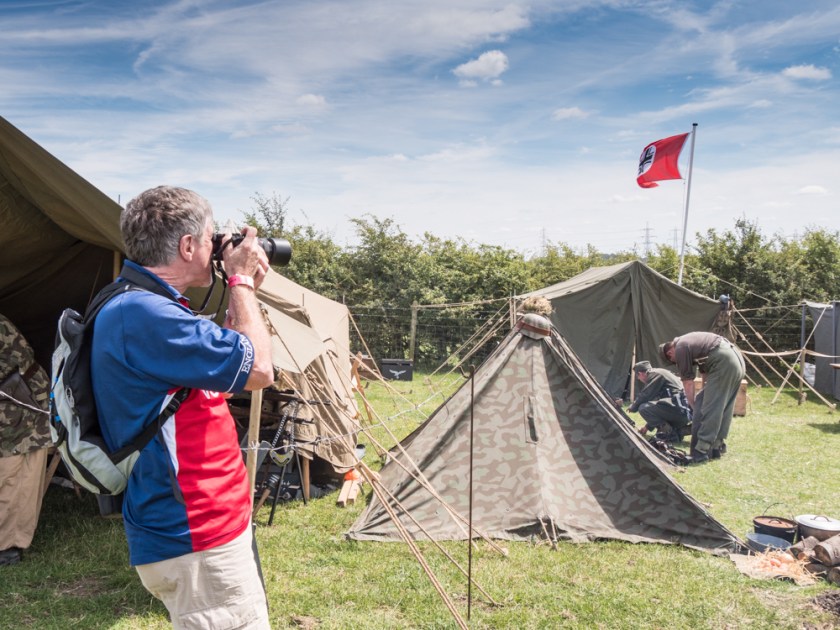
Yorkshire Military Experience – Photographing the Campground
untitled-82
Fort William – Photographing Loch Linnhe in the Rain
untitled-83
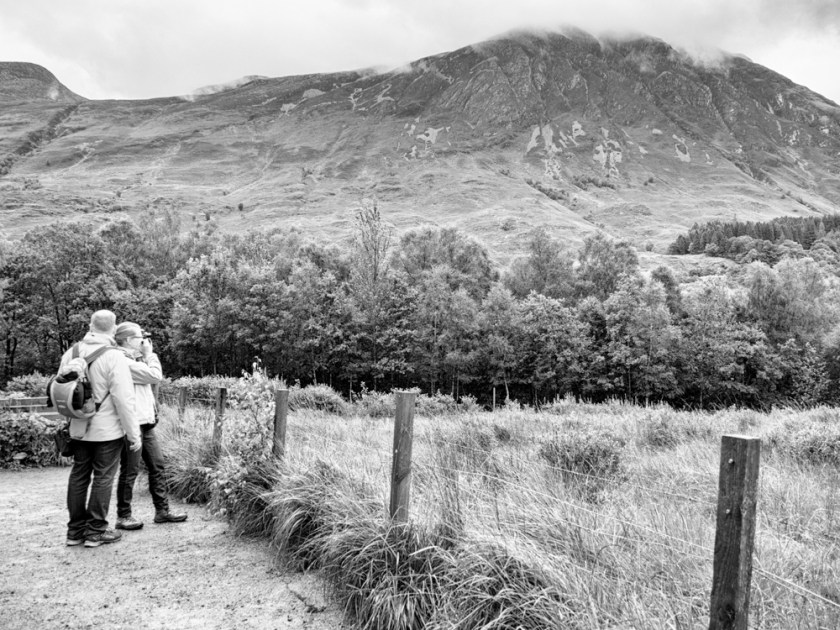
Fort William – Photographing the Mountains
untitled-79
Carlisle – Hadrian’s Cavalry Charge

I was particularly pleased with the last image as I was standing very close to the photographer in front of me and, by sheer luck, managed to get the horses showing on their camera’s screen just as they were charging towards us.

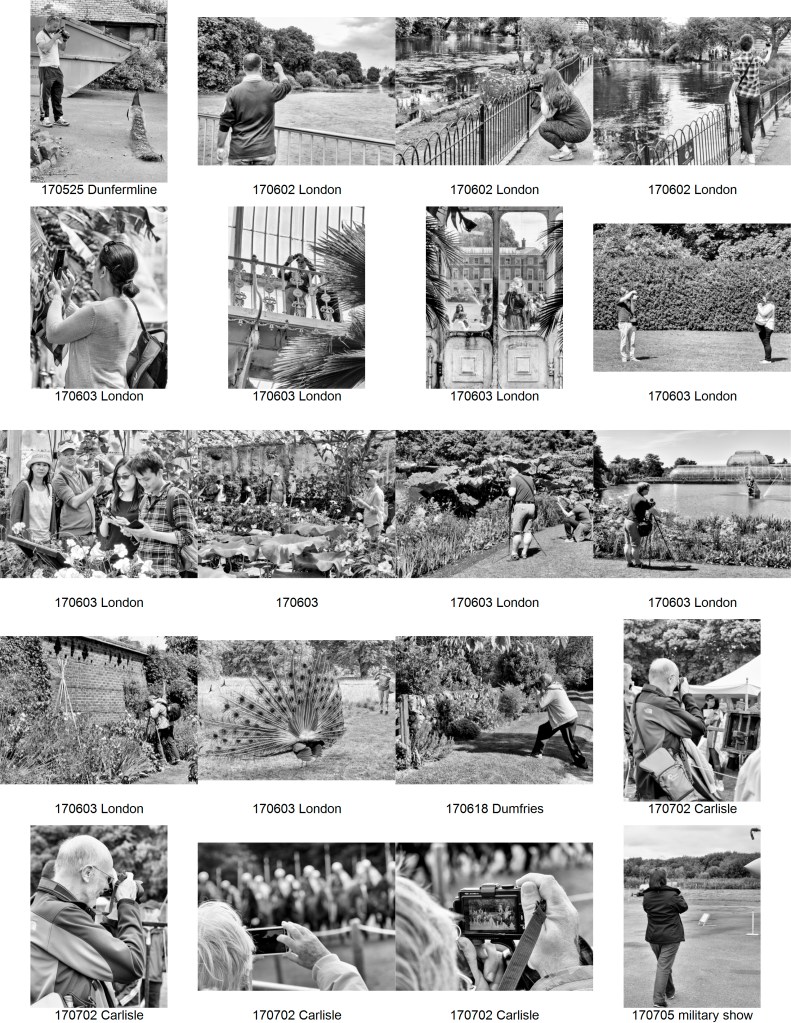
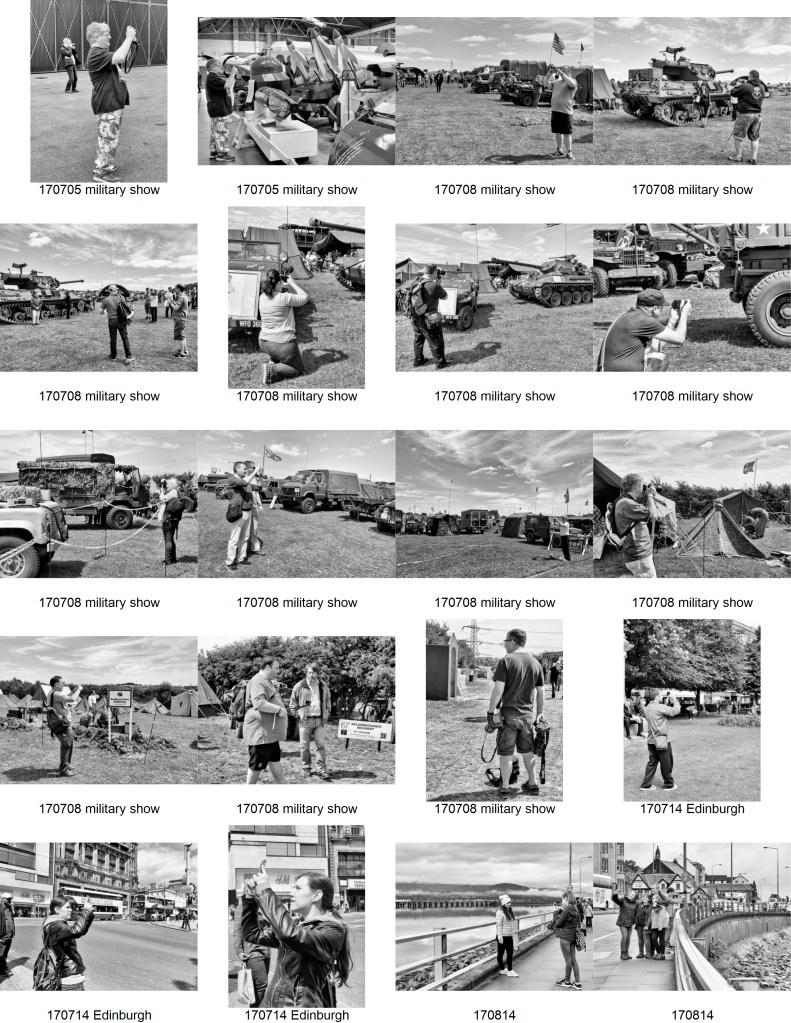
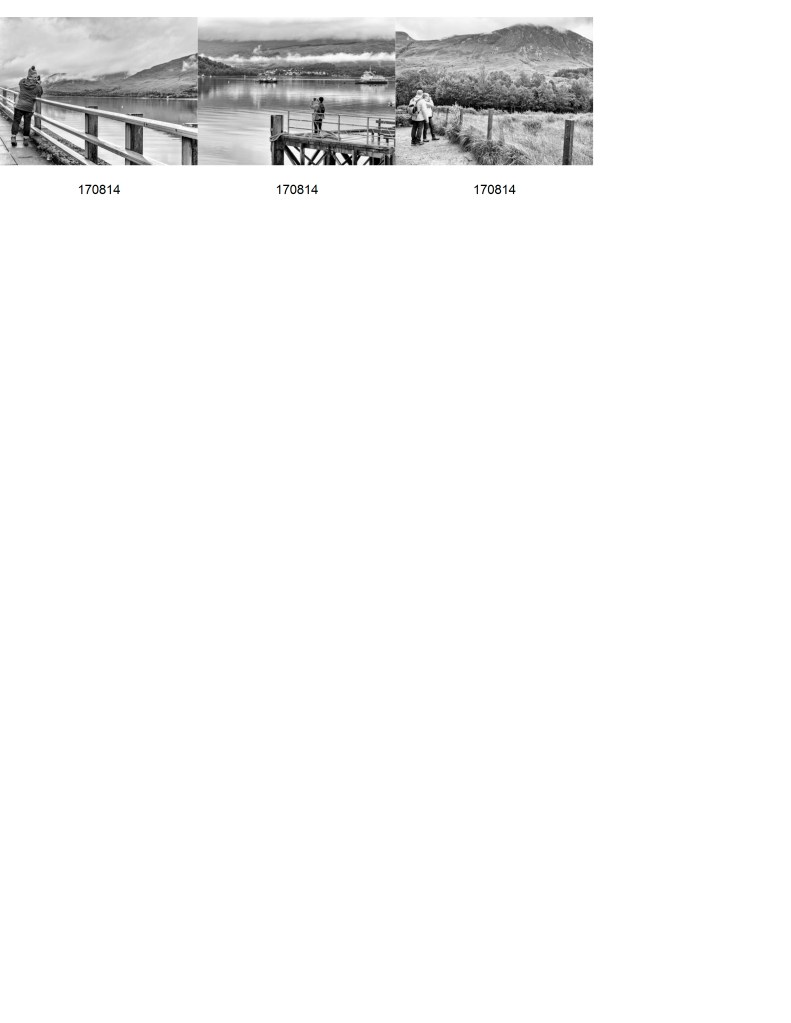
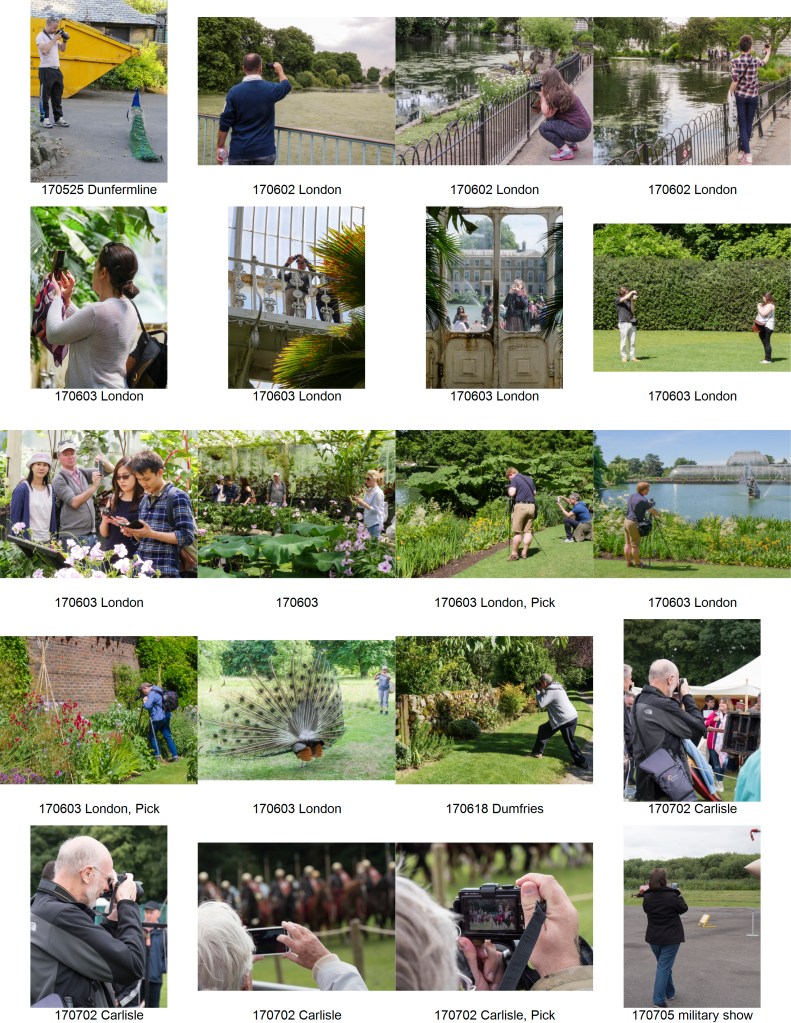
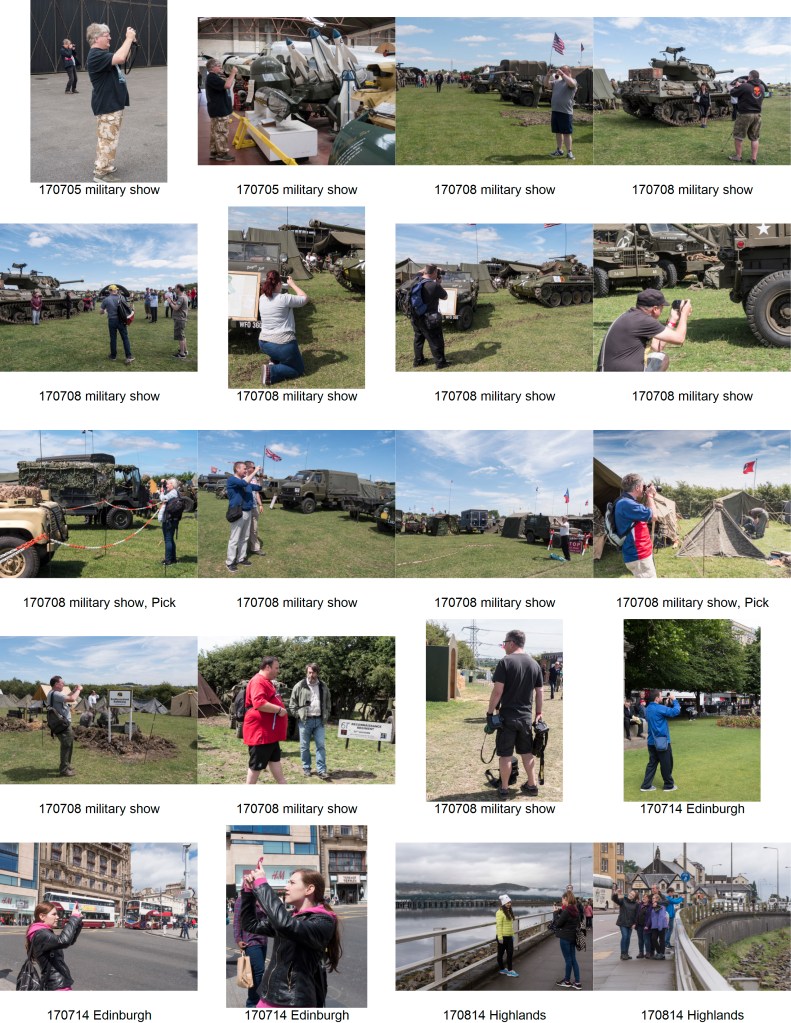
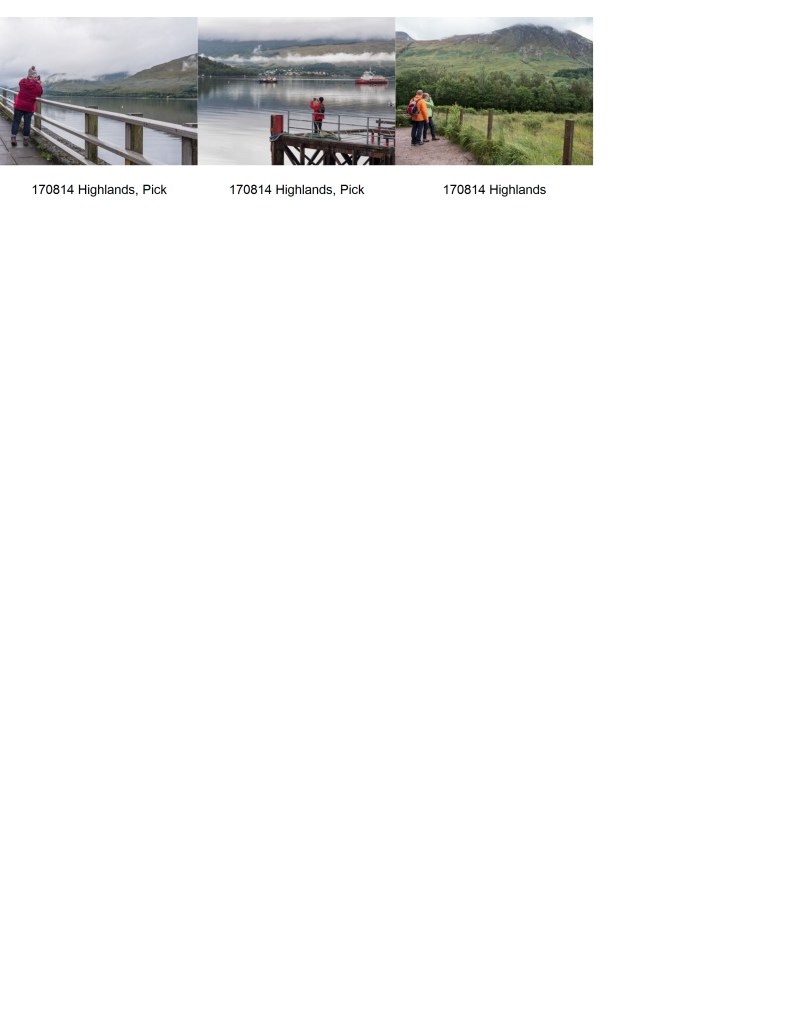
Contact Sheets.

References

Amateur Photographer (2017). Amateur Photographer, (12 August 2017), p.5.

Clarke, G. (1997). The photograph. Oxford [etc.]: Oxford University Press.

Farago, J. (2017). Cindy Sherman Takes Selfies (as Only She Could) on Instagram. [online] Nytimes.com. Available at: https://www.nytimes.com/2017/08/06/arts/design/cindy-sherman-instagram.html [Accessed 18 Aug. 2017].

OUPblog. (2013). Scholarly reflections on the ‘selfie’ OUPblog. [online] Available at: https://blog.oup.com/2013/11/scholarly-reflections-on-the-selfie-woty-2013/ [Accessed 18 Aug. 2017].

Sherman, C. (2017). cindy sherman (@_cindysherman_) ˖ Instagram photos and videos. [online] Instagram.com. Available at: http://instagram.com/_cindysherman_ [Accessed 18 Aug. 2017].

Exercise 3.3

The exercise is to compare the vision directly with your eyes versus the vision via a camera lens.

When you stand and look at a wide panorama the instinct is to look outwards first, taking in the whole scene and then look at the details. In this exercise you were asked to start with looking at the near ground, moving to the middle and then on to the distance.

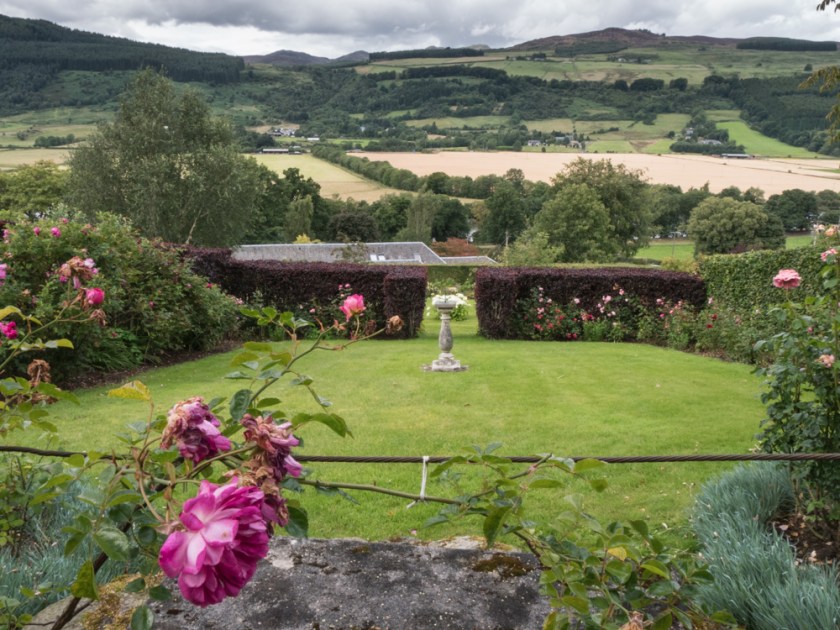
I chose an outside landscape where I was standing on the side of a hill, with the ground falling away from of me, then rising to the hills in the distance. There was a fence just in front of me covered in roses in bloom. On looking at the scene I found that I tended to compartmentalise it into visual ‘rooms’ or areas. After the initial glance at the whole scene I would concentrate on a small piece at a time, such as the roses or the hills in the background. I found myself looking around the area- so taking in a greater field of vision than the camera would, even with a wide angle lens. Your brain automatically interprets what you are seeing as three dimensional (provided that you are looking with both eyes or have other reference points such as size of an object). I found it hard to look at, and take in, the whole area at once.

I then took a photograph without moving from the spot. I used a short focal length to get as much of the image in focus as possible, as your eyes automatically refocus between near and far so everything you are looking at appears in focus. On looking at the image the main differences between what I had ‘seen’ and the photograph were

  • It is ‘flat’ – two dimensional
  • The rose in the foreground is much more prominent than I was aware (and looks larger)
  • The sky is much less prominent- I was automatically looking up, but the image is not large enough to show this even on the widest lens setting I had (14mm)
  • There is no sense of movement – it was a very windy day, even taken at 1/60 sec it has ‘frozen’ the moment
  • There is an odd bit of tree in the top right corner, my brain had ignored it as it was over my head

Learning points:

  • This was an interesting exercise and clearly demonstrates that what your eyes are seeing is not the same as the image you are going to get
  • Be aware of the limitations of the camera
  • Watch for visual distortions with things that are very close to you – the rose

untitled-3

The Decisive Moment – or Not?

The decisive moment as a photographic meme comes from the book ‘The Decisive Moment’ by Henri Cartier-Bresson (Cartier-Bresson, 1852) where, in his introduction he quotes Cardinal de Retz ‘There is nothing in this world that does not have a decisive moment and the masterpiece of good ruling is to know and seize this moment’ (De Retz, 1717).  Cartier-Bresson describes this as ‘the simultaneous recognition, in a fraction of a second, of the significance of an event as well as of a precise organisation of forms which give that event its proper expression’. Interestingly, the book, in its original French printing was called ‘Images à la Sauvette’ meaning images on the run which gives a different emphasis – focusing on the photographer’s actions rather than the moment captured.

The phase and the book have both been discussed repeatedly, by photographers, critics and others with a variety of thoughts on the subject. O’Hagen, in a review of a second edition said ‘For me, what is interesting about the republishing of The Decisive Moment is that it has happened too late. The book is now a historical artefact. It cements an idea of photography that is no longer current but continues to exist as an unquestioned yardstick in the public eye: black and white, acutely observational, meticulously composed, charming. Colour and conceptualism may as well not have happened, so enduring is this model of photography outside the world of contemporary photography itself’ (O’Hagen, 2014). Zouhair Ghazzal said ‘Granted that the decisive moment is more of a cliché than a reality, even for its own creator, it still has the status of a myth with too much of an unconscious impact on photojournalism to be dismissed too easily ……. The decisive moment is therefore that infinitely small and unique moment in time which cannot be repeated, and that only the photographic lens can capture.’ (Ghazzal, 2014) and then he goes on to suggest that in modern cities there is no centre and no individuality that would allow the camera (or presumably the photographer) to capture a decisive moment. In an extensive article, the psychologist John Suler dissects what it takes to make a decisive moment – summarised in a series of 10 rules the final one of which is ‘The DM photo is a product of a unique set of technical, cognitive, and emotional skills developed from extensive training and experience in photography, as well as from a psychological knowledge of people’ (Suler, 2013).

The theme that the decisive moment is no longer relevant is suggested in the review by Colin Pantall of the photobook ‘The Present’ by Paul Graham when he says ‘what he wants us to see is the antithesis of the decisive moment and the spectacle of the urban experience. Instead we get a very contemporary contingency, a street with moments so decisively indecisive that we don’t really know what we are looking at or looking for……. He is not so much showing us something as posing a question; what do we look at when we look at a photograph?’ (Pantall, 2012).  Writing in Black and White Photography Magazine Alex Schneideman argues that ‘street photography… characterised by chance and the interplay between humanity and the built environment is attractive in concept, but not always worthy of the attention it receives…. it has become a gentle pastime that can be successful by its own standards without delving beneath the surface’ (Schneideman, 2017) implying that there has been something lost in the ongoing urge to simply take photographs in the street without focusing on an underlying concept.

Decisive means settling an issue; producing a definite result and having or showing the ability to make decisions quickly and effectively, while moment means a very brief period of time and an appropriate time for doing something; an opportunity or a particular stage in the development of something or in a course of events (Oxford Dictionaries, English,2017).  If you look momentarily outside the field of photography this is discussed in crime novels ‘What is an event, actually? Blinking is an event, going to the toilet is an event, sitting in a café is an event, thinking a thought is an event too. All the things we do and all the things that happen, are events.’ (Horst,2011), autobiography Life isn’t a matter of milestones, but of moments’. (Rose Kennedy, 1974) and music (Pink Floyd, 1973)

Ticking away the moments that make up a dull day
You fritter and waste the hours in an offhand way.
Kicking around on a piece of ground in your home town
Waiting for someone or something to show you the way.

Tired of lying in the sunshine staying home to watch the rain.
You are young and life is long and there is time to kill today.
And then one day you find ten years have got behind you.
No one told you when to run, you missed the starting gun.

So you run and you run to catch up with the sun but it’s sinking
Racing around to come up behind you again.
The sun is the same in a relative way but you’re older,
Shorter of breath and one day closer to death.

Every year is getting shorter never seem to find the time.
Plans that either come to naught or half a page of scribbled lines
Hanging on in quiet desperation is the English way
The time is gone, the song is over,
Thought I’d something more to say.

Thought I’d something more to say –I think this is the important idea that comes out of all the above. A moment in time, all still photography is capturing a moment in time, it may be very short, a millisecond or less, freezing a frame to capture the beat of a hummingbird’s wing or a falling drop, or several days as in the photography of Wesely, or when capturing the movement of the stars at night. The meme of the decisive moment carries with it connotations of black and white street images with an aura of the past, a romanticised view of time gone by and expert photographers swinging Leica’s from their hips to catch a sudden event. Is it still relevant? Yes, but maybe not if you only think of it that way. What is important is saying something about where you are in your moment, your time and what is happening in your space in the world!

Is the decisive moment the image that I began these thoughts with or is it the ending one, where the only person watching is me?

untitled-20

References

Cartier-Bresson, H. (1952). The decisive moment. Göttingen: Steidl.

De Retz (1717). Memoires.

Ghazzal, Z. (2004). The indecisiveness of the decisive moment. [online] Zouhairghazzal.com. Available at: http://zouhairghazzal.com/photos/aleppo/cartier-bresson.htm [Accessed 5 Aug. 2017].

Horst, J. (2011). Dregs.

Kennedy, R. (1974). Times to remember. New York: Doubleday.

O’Byrne, R. (2001). H. Cartier-Bresson: l’amour tout court. [online] Vimeo. Available at: https://vimeo.com/106009378 [Accessed 24 Jul. 2017].

O’Hagan, S. (2014). Cartier-Bresson’s classic is back -but his Decisive Moment has passed. [online] the Guardian. Available at: https://www.theguardian.com/artanddesign/2014/dec/23/henri-cartier-bresson-the-decisive-moment-reissued-photography [Accessed 4 Aug. 2017].

Oxford Dictionaries | English. (2017). [online] Available at: https://en.oxforddictionaries.com/definition/decisive [Accessed 5 Aug. 2017].

Pantall, C. (2012). photo-eye Book Reviews: The Present. [online] Blog.photoeye.com. Available at: http://blog.photoeye.com/2012/05/photo-eye-book-reviews-present.html [Accessed 5 Aug. 2017].

Pink Floyd (1973). Time (The Dark Side of the Moon). Harvest Records.

Schneideman, A. (2017). Thinking Photography. Black and White, (February), pp.62-65.

Suler, J. (2017). Photographic Psychology: The Decisive Moment. [online] Truecenterpublishing.com. Available at: http://truecenterpublishing.com/photopsy/decisive_moment.htm [Accessed 4 Aug. 2017].


L’amore de court – Just plain love

A documentary about Henri Cartier-Bresson, made in 2001 when he was 93.

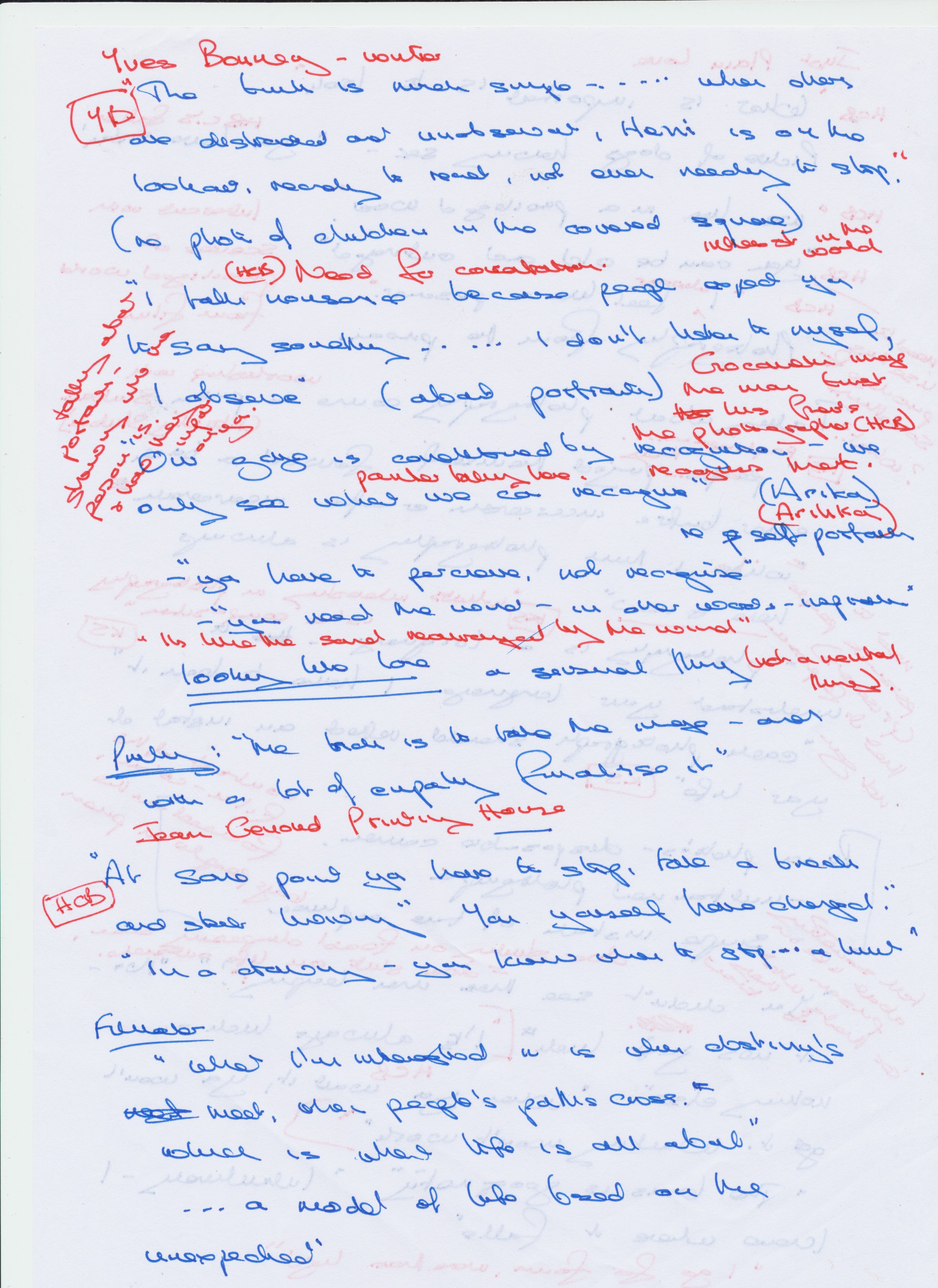
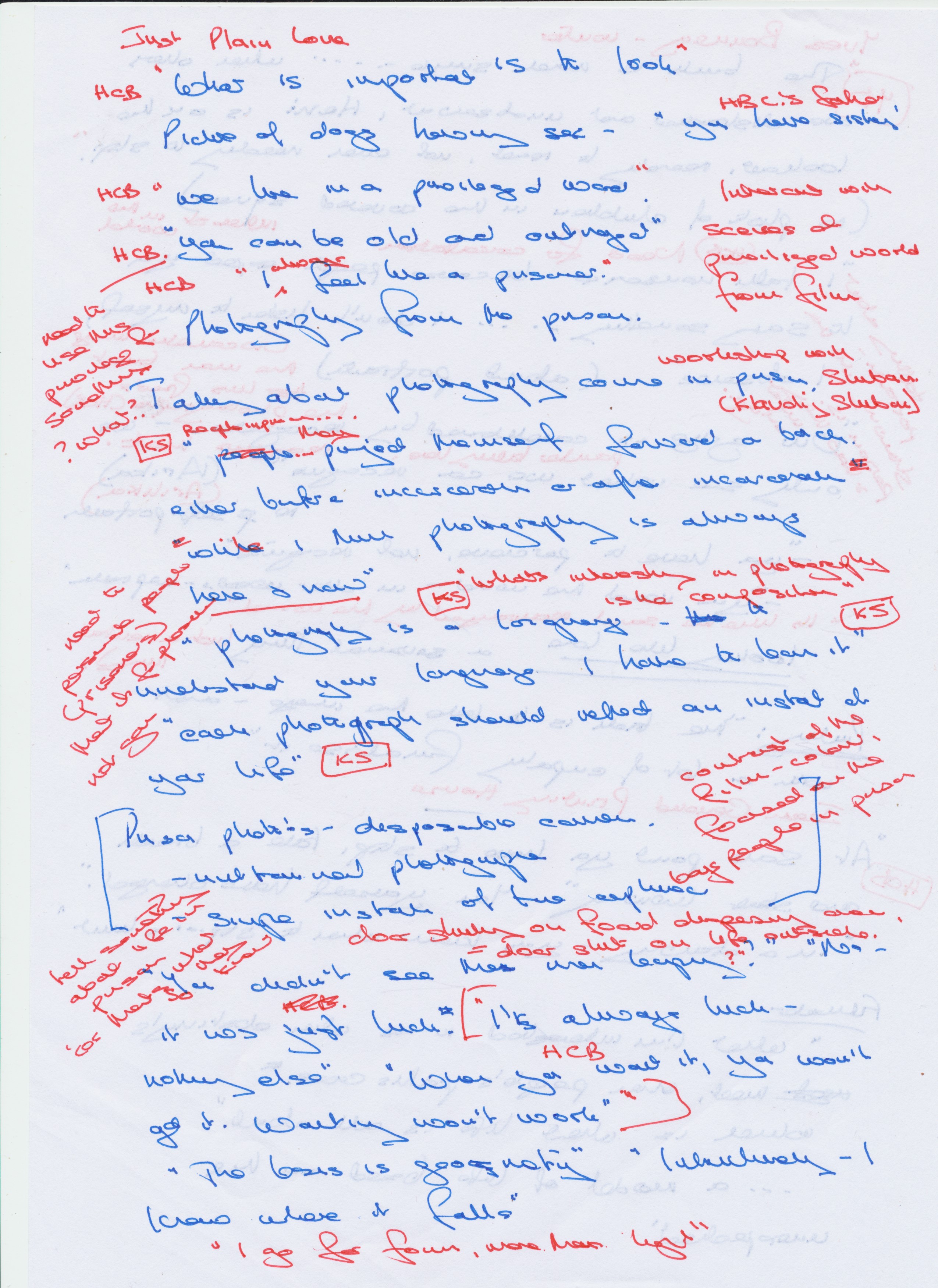
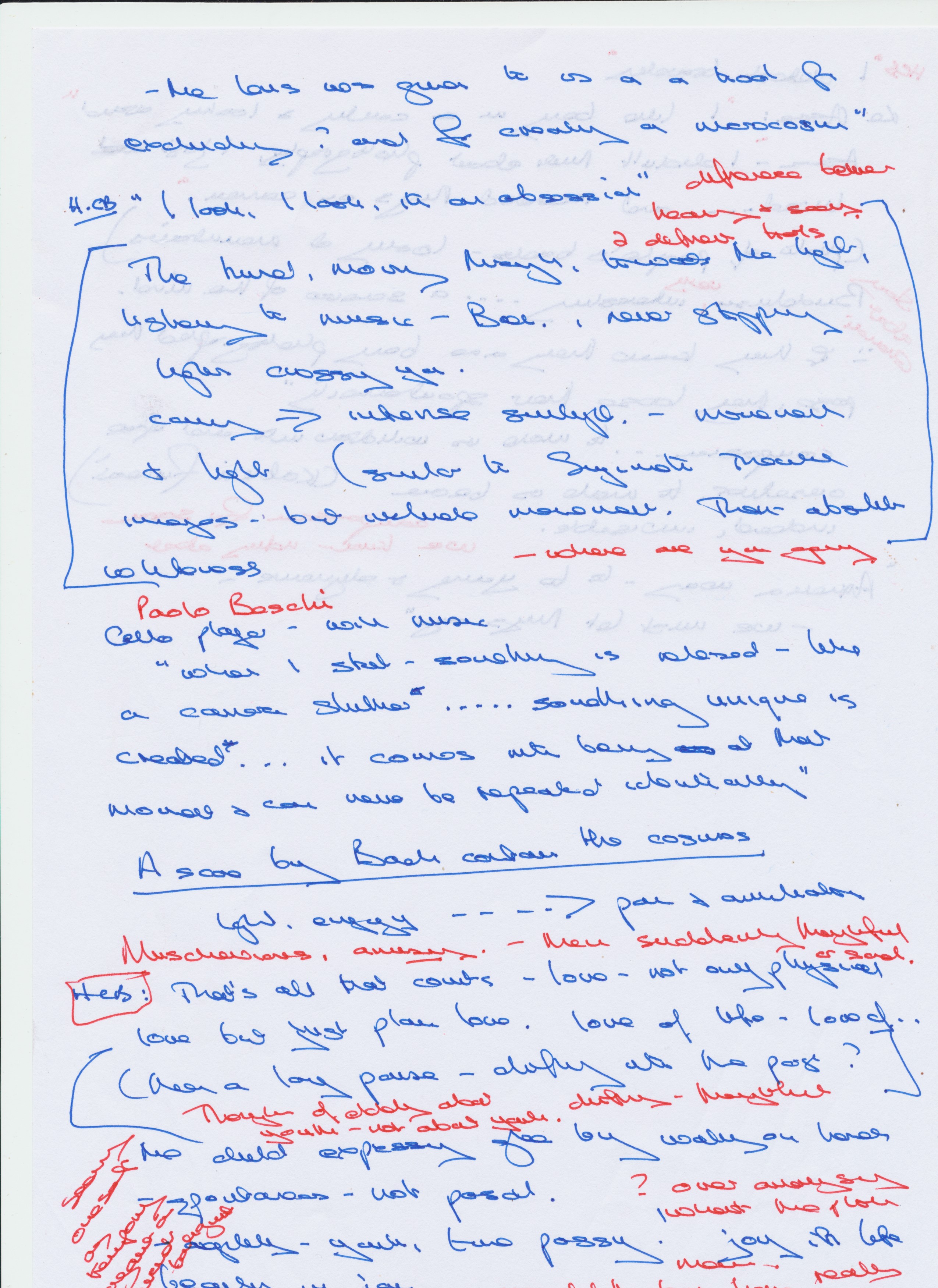
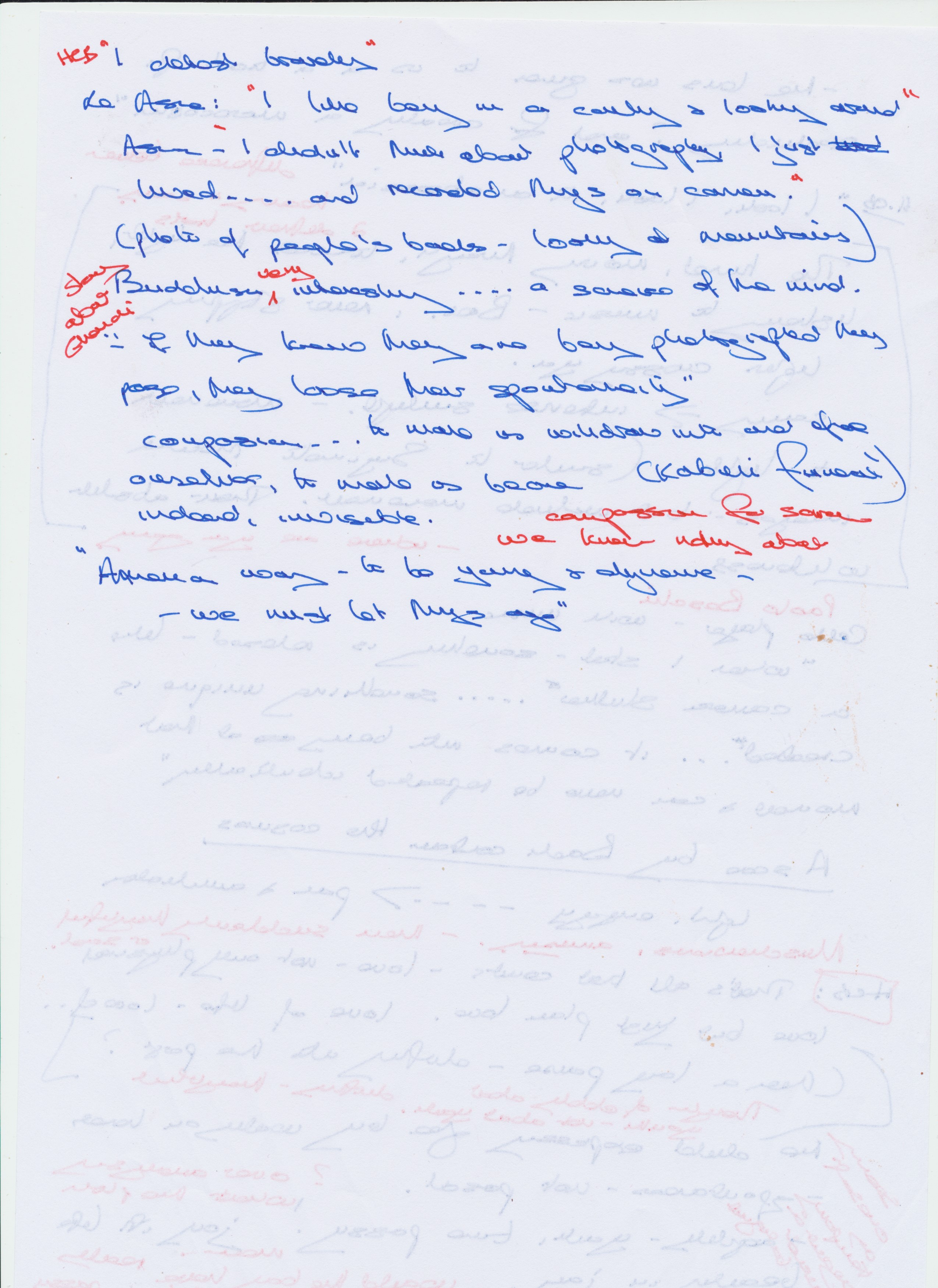
I watched this documentary twice, taking extensive notes (which I will append as PDF’s). The film switches between Cartier-Bresson talking about his thoughts on photography and the thoughts of other creative people talking about their fields, painting, film and music. There is an implied comparison between these different art forms and photography together with suggestions about how they are similar. It is clear throughout the documentary that both the film makers and the other creative people talking had a great affection for Cartier-Bresson and that he has maintained a mischievous nature. He clearly had a wonderful sense of humour which comes over in his photography and also in his conversation with others. All quotes are from the documentary (O’Byrne,2001).

Cartier-Bresson’s main themes are ‘what is important is to look’ and ‘we live in a privileged world’ and therefore that you should make use of that privileged position to show what is important and truthful in life. He talks about luck ‘It’s always luck, nothing else. When you want it, you won’t get it’ and about his feeling that the most important part of a good image is form ‘the basis is geometry …. Intuitively I know where it falls.’

There is a fascinating section by the photographer Klavdij Sluban which shows taking disposable cameras into a prison from youths, talking to them about the basis of composition and then letting them take their own images. There is a marked contrast between the professional and emotive film showing the young men, focusing on small details of their lives such as the food hatch and the images taken on the cheap cameras which shows what the prisoners themselves found important, mainly images of each other, often in groups and often unposed, all the more evocative of their actual lives.

Yvette Bonney says about Cartier-Bresson ‘when others are distracted and unobservant, Henri is on the lookout, ready to react, not even needing to stop’. In contrast, Cartier-Bresson talks about the need for concentration and how, when talking portraits ‘I talk nonsense because people expect you to say something …. I don’t listen to myself, I observe’.

Arihka (a painter) says ‘you have to perceive, not recognise’ and ‘it’s like the sand rearranged by the wind …. You need the wind, in other words, inspiration …. a sensual thing’, and Paolo Beschi (a cellist) says ‘when I start something is released …. like a camera shutter…. something unique is created ‘.

 Parts of the film were poignant, parts funny and all fascinating. A scene of driving though a tunnel to the light reminded me of the theatre images by Sugimoto, but with an intense sense of motion rather than the stillness Sugimoto imparts. It reminded me that all senses are linked, and that although in photography we are mainly using our eyes and looking, an image can also invoke the memory of sound, feeling and the gestalt of a place or a person. A good image needs love.

Reference

O’Byrne, R. (2001). H. Cartier-Bresson: l’amour tout court. [online] Vimeo. Available at: https://vimeo.com/106009378 [Accessed 24 Jul. 2017].


Further Thoughts on Assignment 2

Gill, Dijkstra and Gotts.

As part of his feedback for assignment 2 my tutor suggested I should look at some portrait photographers who work in different ways. Each produces a typology of ‘heads’ (and shoulders!) that you may find interesting. What links these photographers and yourself is the idea of linking the portraits through a common theme.’

I found this very interesting, and could have ended up spending the next several weeks just on this part of an assignment review.

Stephen Gill (born 1971) is widely exhibited, but also produces a series of handmade photobooks on his latest series of images. Field Studies is one of these and is described on the publishing website as ‘serial studies of mundane British scenes and objects including cash points, lost people, the back of advertising billboards and people traveling on the London to Southend train. His visual approach is unique, combining conceptual rigour with enormous sympathy for his human subjects’ (Gill, 2004). This book includes his ‘Audio Portraits’ of people wearing headphones. In these images the people seem totally bound up in their music, looking far away at times, and not always aware of the photographer. The images show a range of ages and races, the only apparent link is the headphones, and the place – a city street. A further series focuses on the shopping trolleys people use, apparently secondary to his use of a trolley after an injury (Gentle Author, 2011). I found these portraits fascinating as they focused on the everyday lives of people you see in the street, not the famous, the great or the good, but the people you meet and probably normally just walk past. He clearly engaged with them and enabled them to relax, or even to ‘chill out’ while taking a portrait that is sympathetic but not full of pathos, and which includes the often drear surroundings.

Rineke Dijkstra (born1959) has just won the 2017 Hasselblad Foundation International Award in Photography. She concentrates on portraiture, often works with series, either of the same person over a prolonged time period or of a specific event in peoples lives. She has photographed bullfighters just out of the ring, adolescents on the cusp of adulthood and a series of images of women just after childbirth, which is one of the most vulnerable points in any woman’s life. Her work is described as deadpan by Cotton ‘The unsentimental approach that Dijkstra makes in her representation of maternity…… visualised the profound shift in the women’s changing relationships to their bodies…… something we might never have observed without such a systematic and detached photographic style’. (Cotton,2014).

Smyth says in the BJPRineke Dijkstra’s photographs and films speak brilliantly to the intricacy of the portrait image: its embodiment in time; its capacity to reveal history; the contingency of the act of exchange between sitter, photographer and spectator; and, ultimately, photography’s revelation of the self.’ (Smyth, 2017)

On describing her 2012 retrospective Time Magazine says ‘Hoping to catch people with their defences down, Dijkstra started to photograph them in the aftermath of some exhausting event. She got women to pose soon after giving birth, usually standing naked while they cradled their new-borns. By 1994 she was also making portraits of Portuguese forcados—amateur bullfighters who enter the ring in unarmed groups to subdue the bulls bare-handed. She photographed them right after they returned from the fight, bloody, scuffed and dented.’ (Lacayo, 2012).

I find her work poignant, it may well be systematic, but it is not detached. She shows life in all its variable glory, ups and downs as well as the spectacular moments.

I also found Andy Gotts who, amongst other images, has produced a series of portraits of BAFTA award winners that was exhibited under the title ‘Behind the Mask’ in 2014.  The images are show the great and good of the acting world who have either won or been nominated for a BAFTA. Gotts says, ‘I have always been a movie buff and getting the opportunity to meet my matinée idols is beyond a dream come true’ (Bafta.org,2013).  Janette Dalley, who worked with him on the exhibition describes ‘a masterclass in minimalist photography’ (Gotts, 2014) and Anna Allalouf, the curator, says ‘it feels profoundly vulnerable to go under the camera’s gaze when you don’t have a ‘role’ …. perhaps the camera has stolen (heaven forbid!) a little piece of one’s soul’ (Gotts, 2014) but goes on to describe how his simple and quiet process does not actually feel invasive.

The images are a mixture of colour and monochrome, chosen, I feel, to reflect the person. Some are contemplative, some brash and some, such as the portrait of Ralph Fiennes, made me initially smile, and then laugh out loud. The two that I found most entrancing were Sir Ian McKellen (Gandalf, among other roles) and Christopher Walken – to me an unfamiliar face, but the portrait makes me feel I might know him. It is this quality of intimacy that drew me to his images. The people are famous and must have been photographed many, many times, but there is a feeling of Gotts reaching out to who, not just what, they are. This is a quality I would like to be able to emulate.

Learning points:

  • Observation not invasion
  • Both colour and monochrome are valuable – but give a different feeling
  • Know and understand your subjects
  • Be gentle (not quite the correct word – but neither is kind).

References

Bafta.org. (2013). BAFTA and Andy Gotts MBE to Exhibit ‘Behind The Mask’ Photography. [online] Available at: http://www.bafta.org/media-centre/press-releases/bafta-and-andy-gotts-mbe-to-exhibit-behind-the-mask-photography [Accessed 21 Jul. 2017].

Cotton, C. (2014). The photograph as contemporary art. London: Thames & Hudson.

Gentle Author (2011). Stephen Gill’s Trolley Portraits | Spitalfields Life. [online] Spitalfieldslife.com. Available at: http://spitalfieldslife.com/2011/10/03/stephen-gills-trolley-portraits/ [Accessed 25 Jun. 2017].

Gill, S. (2004). Hackney Kisses. [online] Stephen Gill. Available at: https://www.nobodybooks.com/product/hackney-kisses-print-edition [Accessed 25 Jun. 2017].

Gotts, A. (2014). Behind the mask. London: British Academy of Film and Television Arts.

Lacayo, R. (2012). Rineke Dijkstra Makes the Awkward Sublime. [online] Time.com. Available at: http://time.com/16182/rineke-dijkstra/ [Accessed 25 Jun. 2017].

Smyth, D. (2017). Rineke Dijkstra wins the 2017 Hasselblad Award. [online] British Journal of Photography. Available at: http://www.bjp-online.com/2017/03/rineke-dijkstra-wins-the-2017-hasselblad-award/ [Accessed 25 Jun. 2017].

Exercise 3.2

Using a method inspired by the example above record a trace of movement within the frame.

I found this exercise both interesting and frustrating. After reading about it I remembered some images of fairground rides I had taken some years ago using a slow shutter speed to show movement and had planned to repeat the exercise and see what happened. Unfortunately, despite it being summer, and visiting a number of events I did not find any fairground attractions. I have three of the original images below to show the effect I was after. The intensity of colour and the movement blur really emphasised the excitement of the fair.


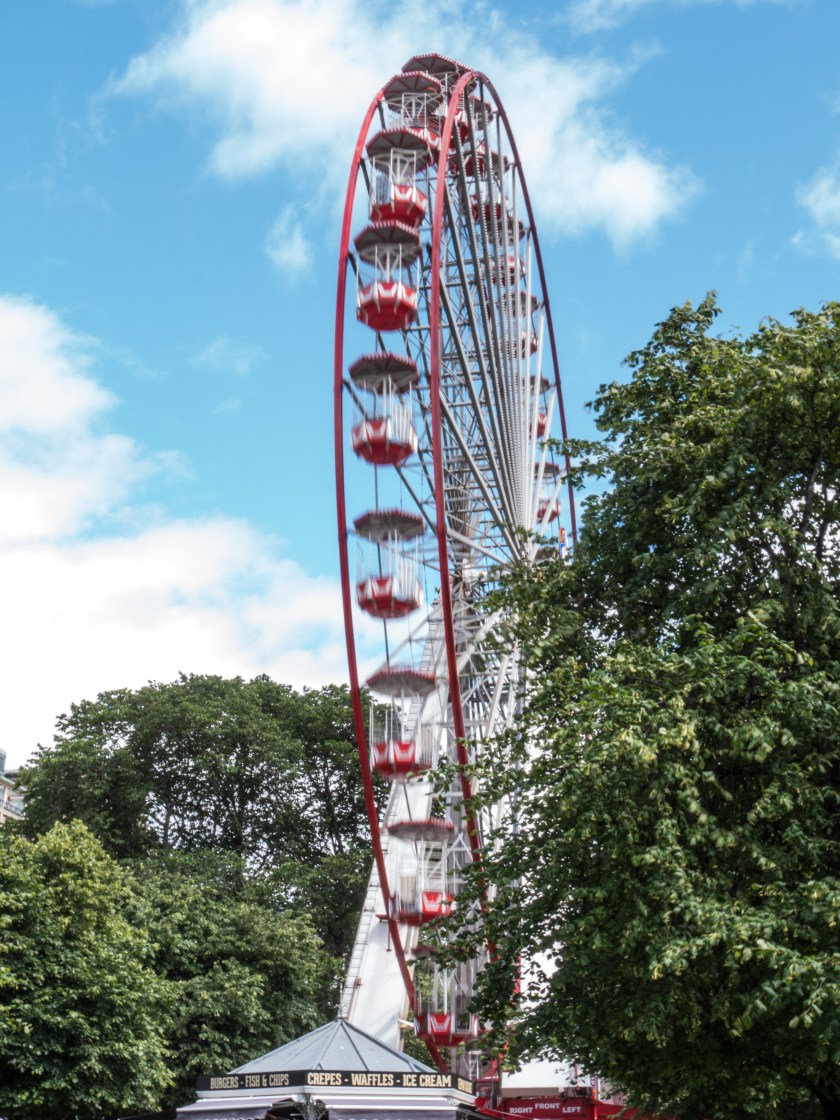
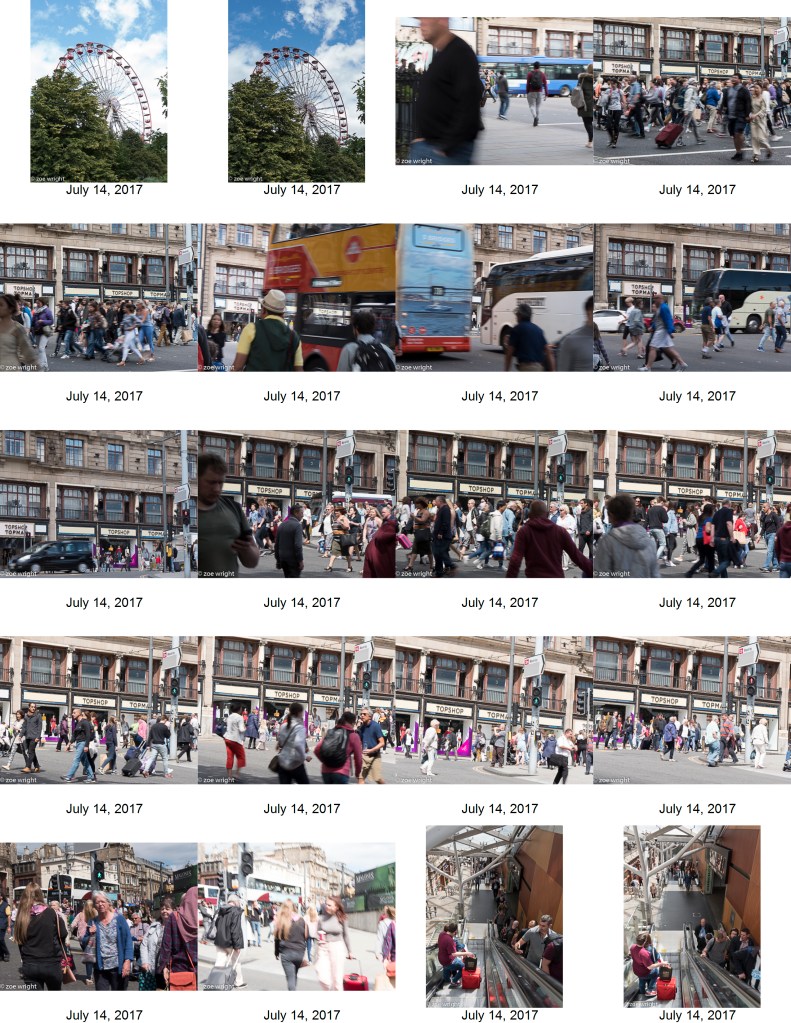
The nearest I got to repeating it was the image of the big wheel below, but it wasn’t really moving fast enough to show a good blur. This would have been more successful if I had been able to take the image at night with blurred lights. This was taken at a shutter speed of 1/8th sec handheld, and even then was very overexposed and had to be significantly modified in Lightroom. A much longer exposure might have worked with the aid of a tripod.

untitled

Another image type I have played with in the past is night shots, either using a long exposure time and relying on the movement of vehicle to give trails of light or by moving the camera and thus causing the light trails artificially. I thought about replicating these but decided to just show some of the original images to give the idea.


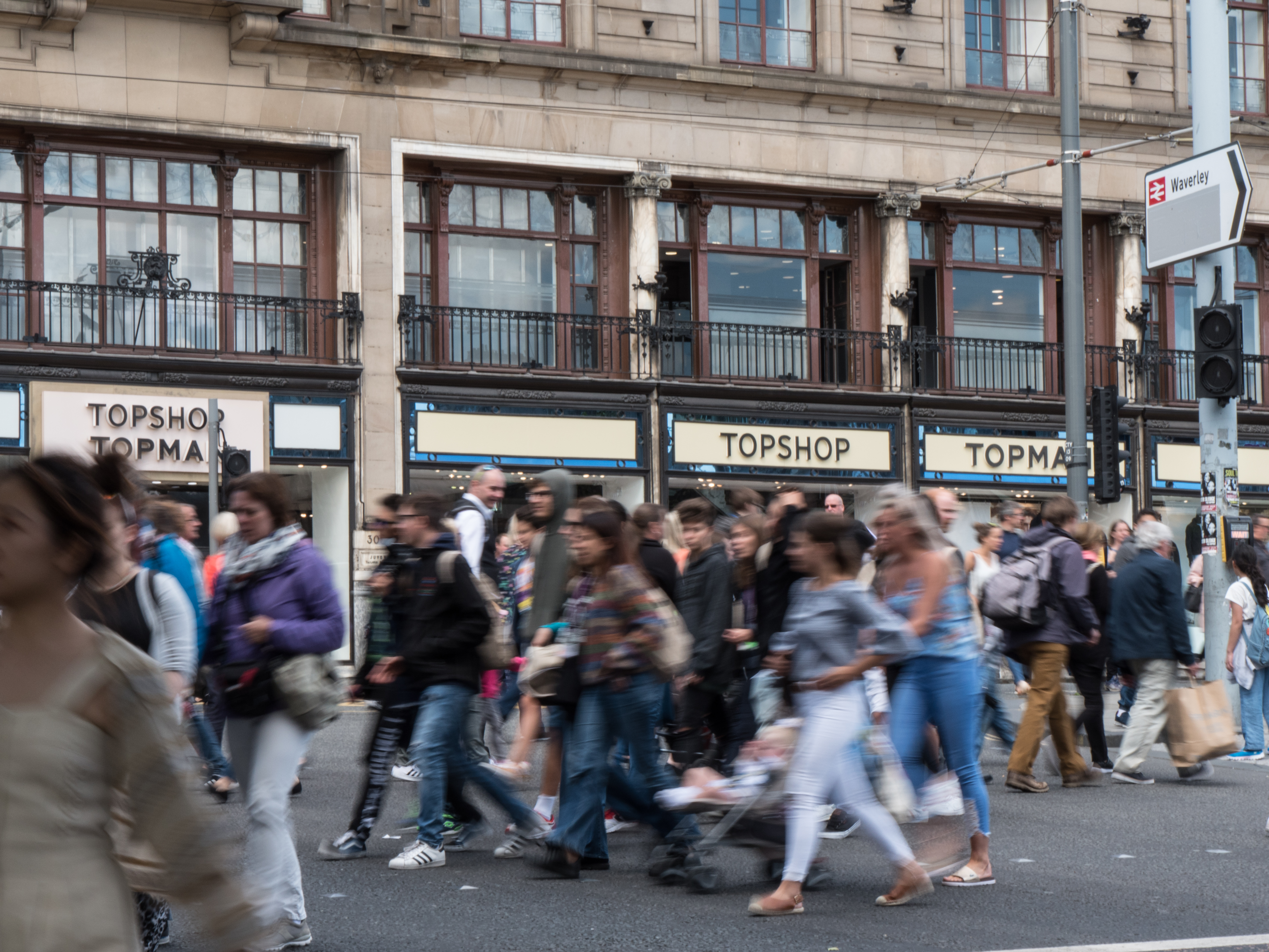
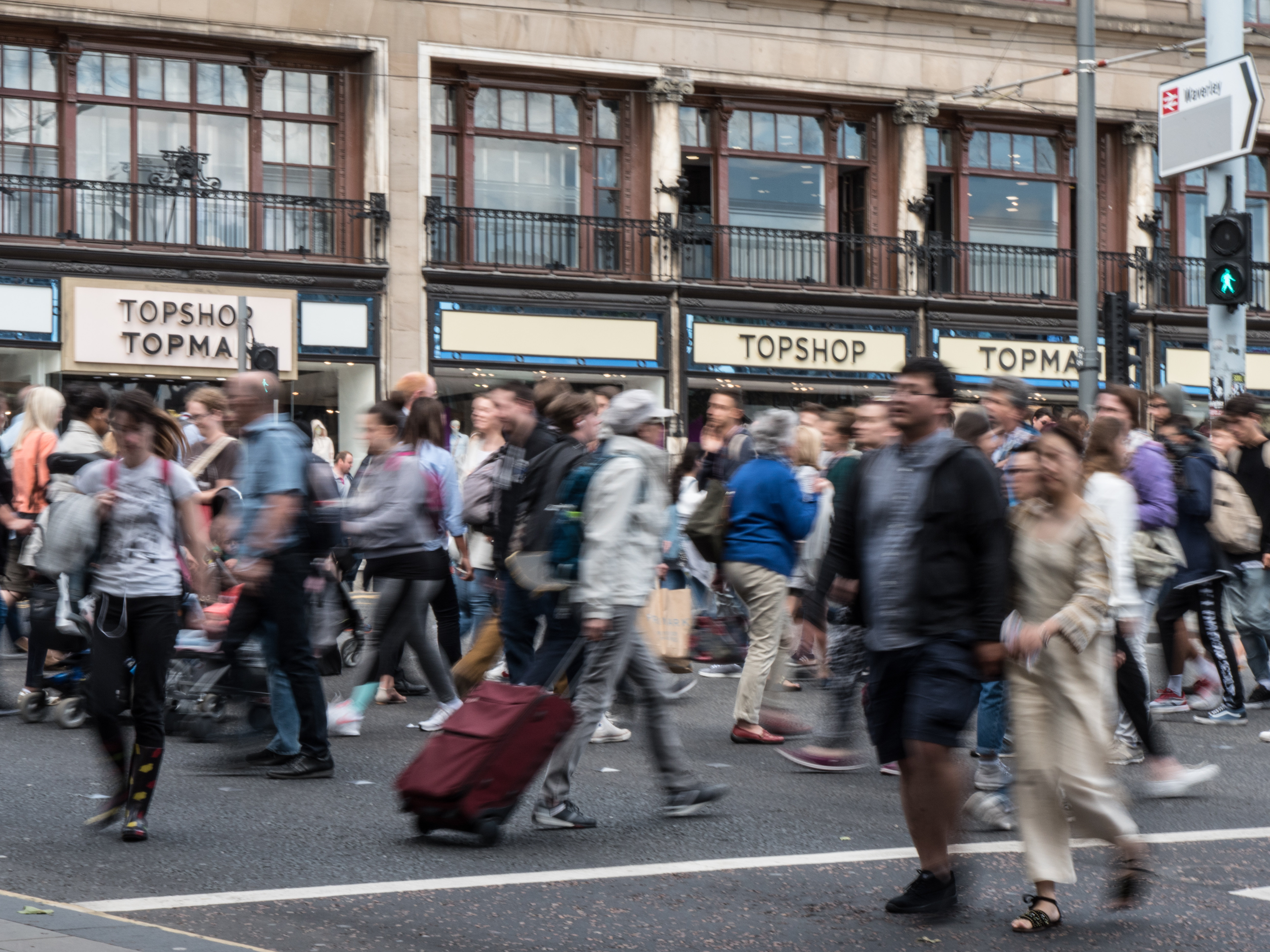
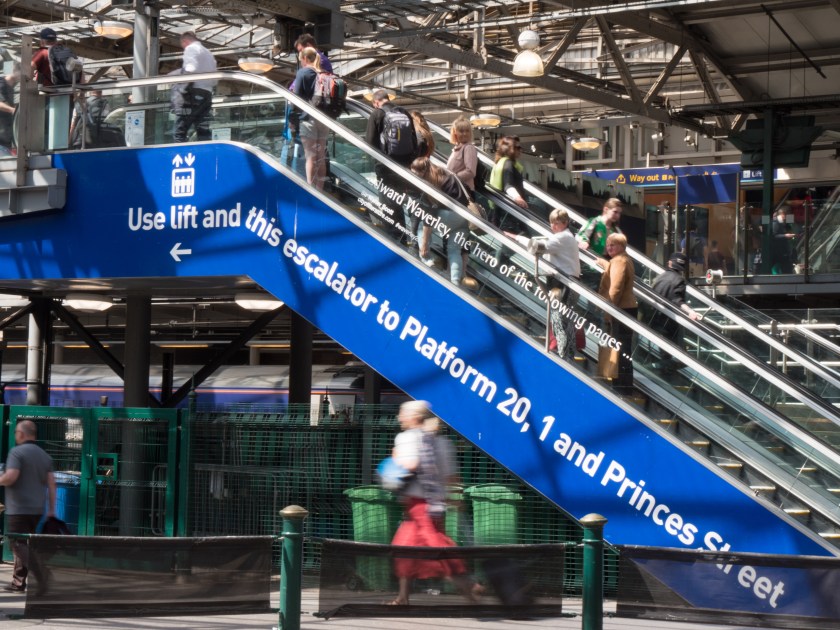
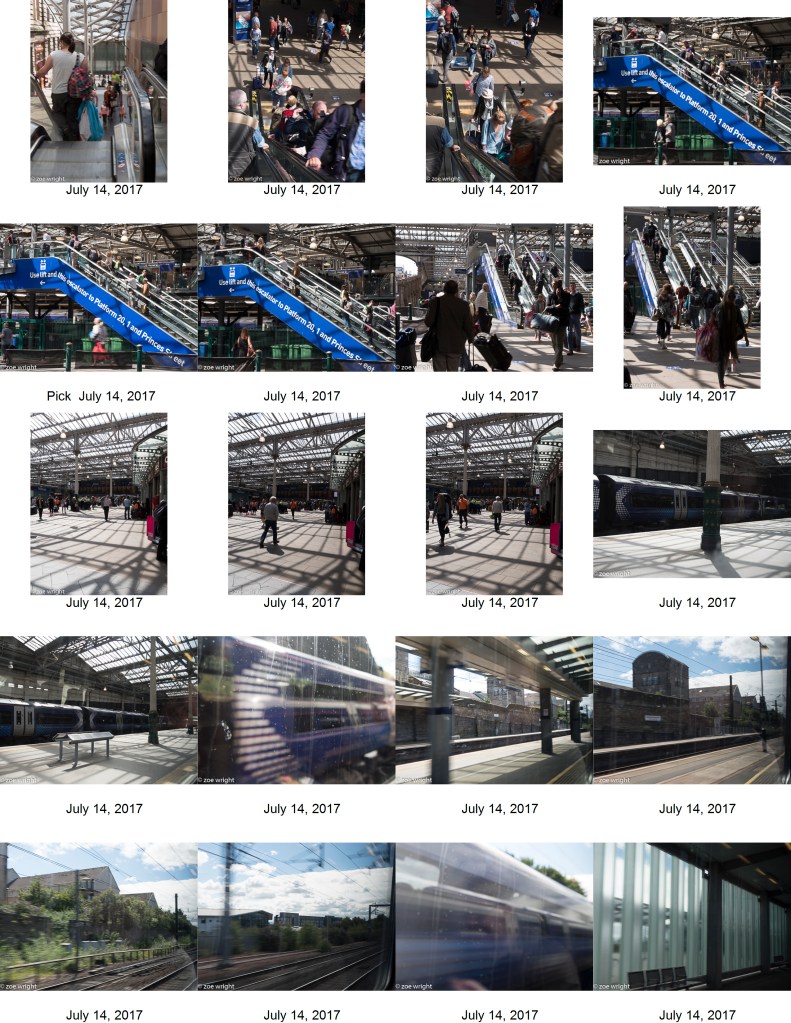
I then decided to try to show the rush and thrust of a busy place, using a slow speed to emphasise the movement of the people. I experimented with this on Princes Street in Edinburgh at about lunchtime and also in Waverly Station.


I liked these images as I feel they give an idea of the pushing and hurry of trying to cross a street. Interestingly I found that I was automatically trying to follow the people while they were moving and had several images where the people were sharp but the background blurred, which was not the image I was aiming for.  I really need to go back with a tripod and try and retake these, although it will be difficult to find somewhere to set up a tripod where I can both see the crossing and not be knocked over by the rush of people. These 2 images were taken at 1/15 sec at f/22.

untitled-5

This was taken in Waverly Station, again shows the busyness of the place, but I liked the effect of the woman running, presumably she was risking missing her train, and felt that this image told a strong story. This was taken at 1/20 sec at f/20.

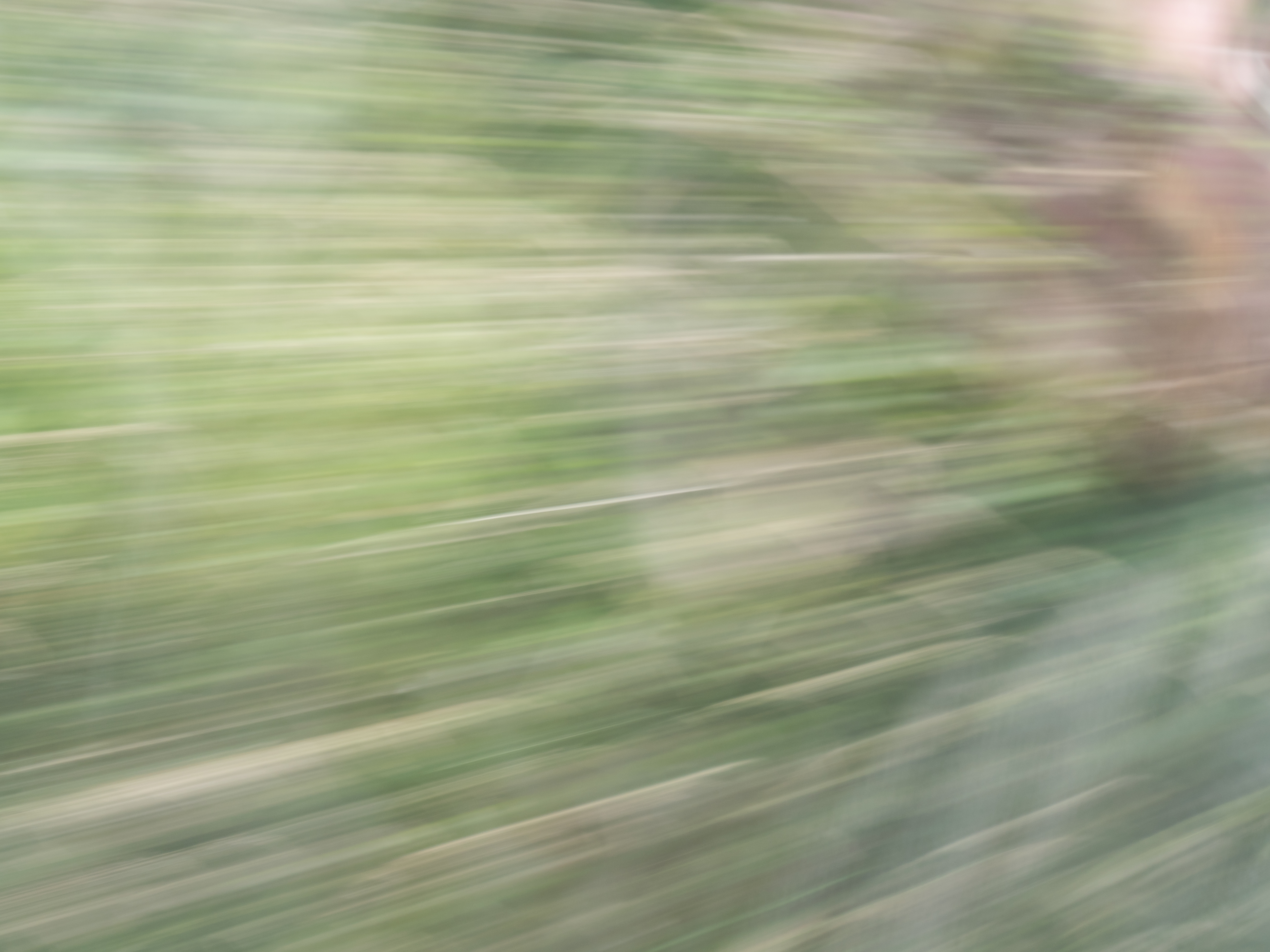
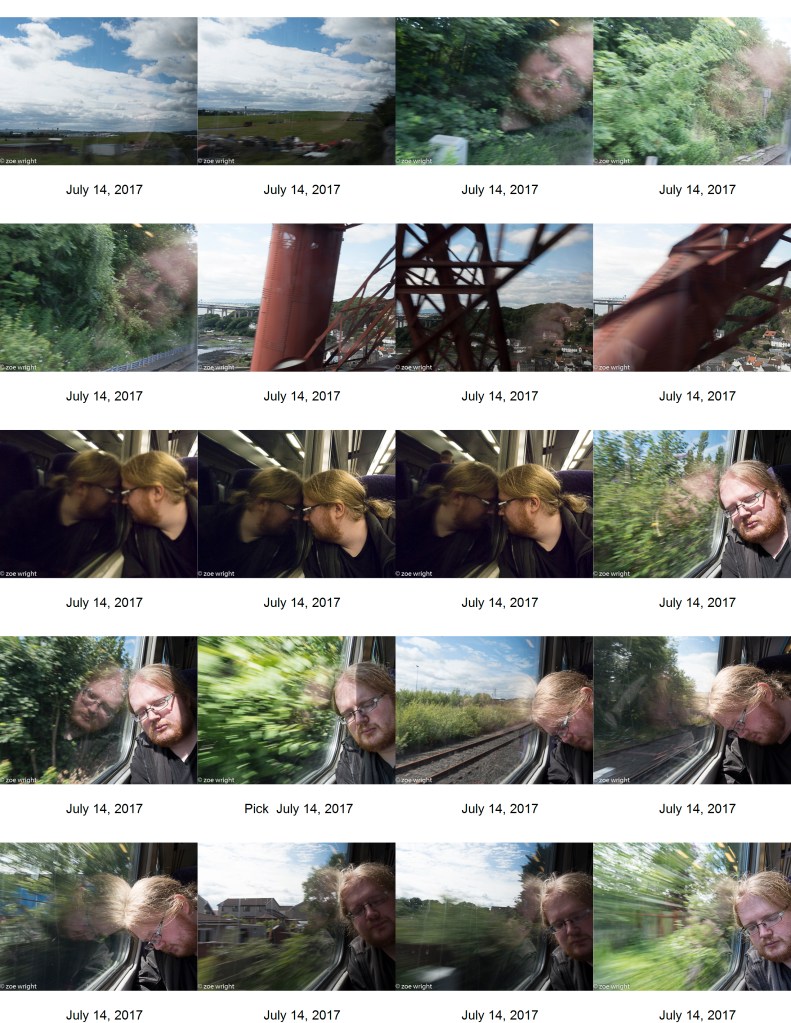
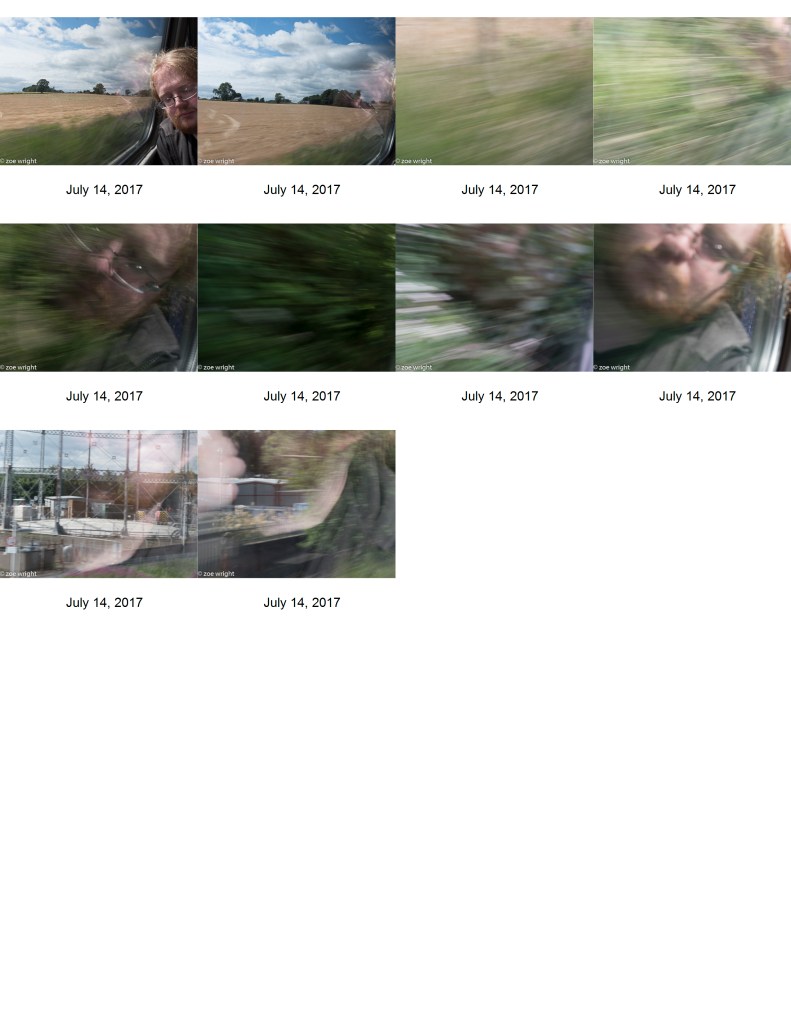
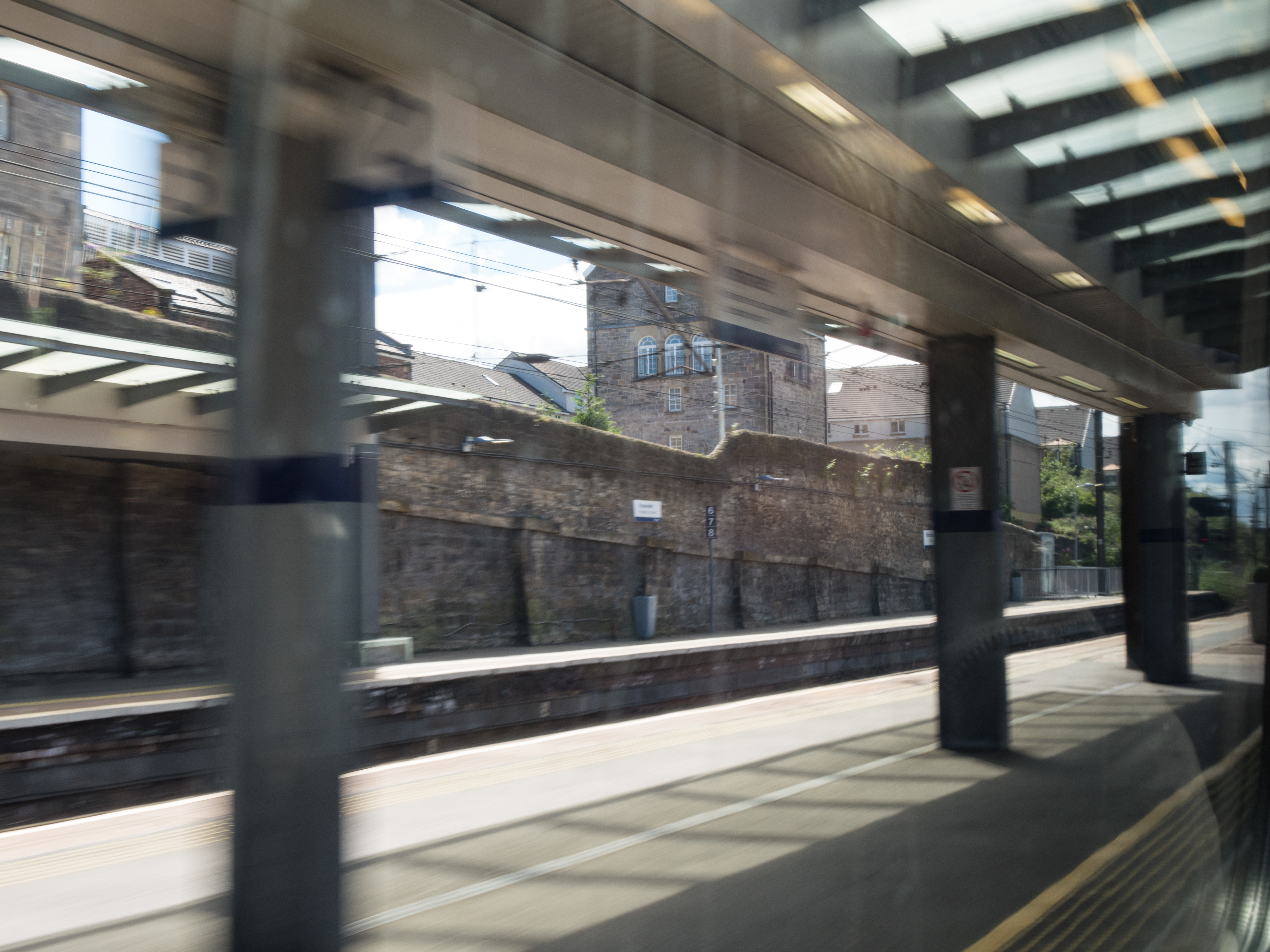
I also experimented with images where the shutter speed was quite fast but I was moving rapidly, in this case on a train, looking out of the window. The initial images were not successful as they tending to show the dirty window rather than the view. Images just looking outside gave a good movement blur – but could have been taken anywhere, or looked as if I was not holding the camera still. The more distant part of the image below does retain relative clarity compared with the actual station, so could be worth experimenting further.


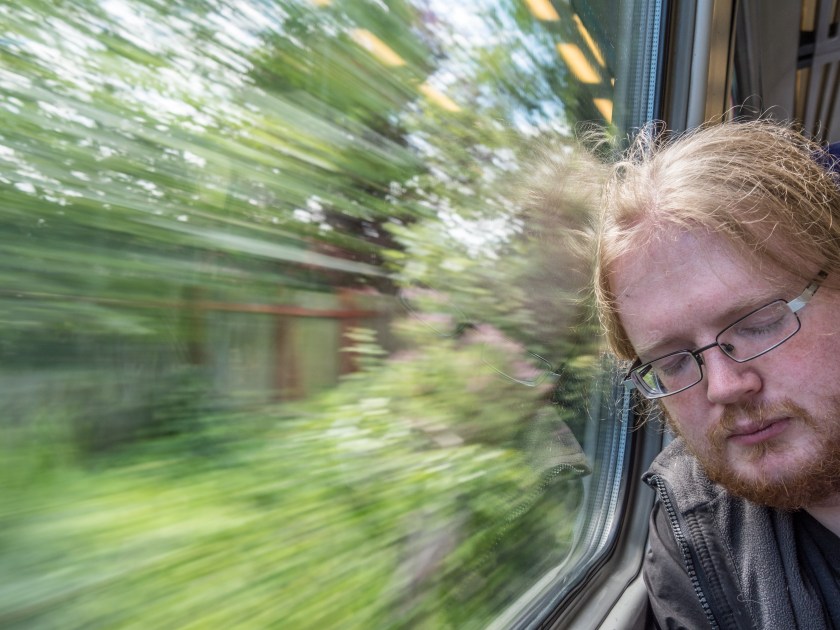
I then used my son, who was almost asleep with his head on the window, and focused on him. This gave an interesting contrast of the in-focus person inside the train compared with the intense sense of movement outside the train and I felt was the most successful of this series of images. Taken at 1/30 sec at f/5.6 the blur will have been exaggerated as I was focusing on the nearer person.

untitled-12.jpg

Learning Points:

  • Movement can be shown in a multiplicity of ways
  •  Just because it’s a single image time doesn’t have to be static
  • Think about the story you are trying to tell

A Durational Space

Capa, Sugimoto and Woodman
PAR121453_Social_Media_Watermark(1)

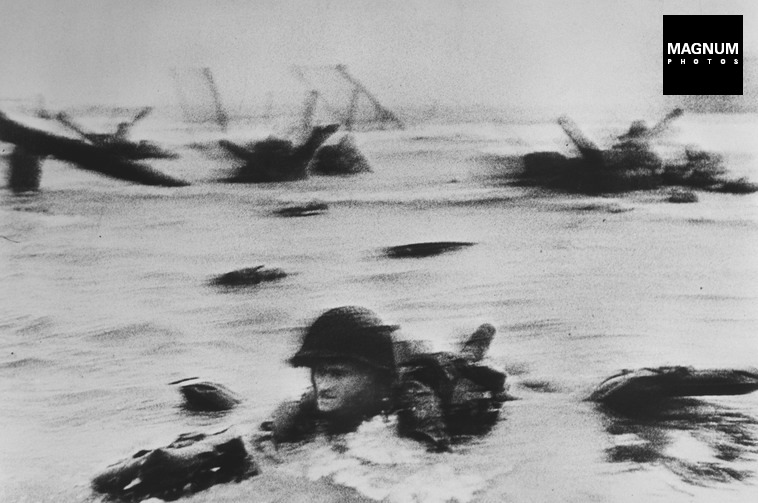
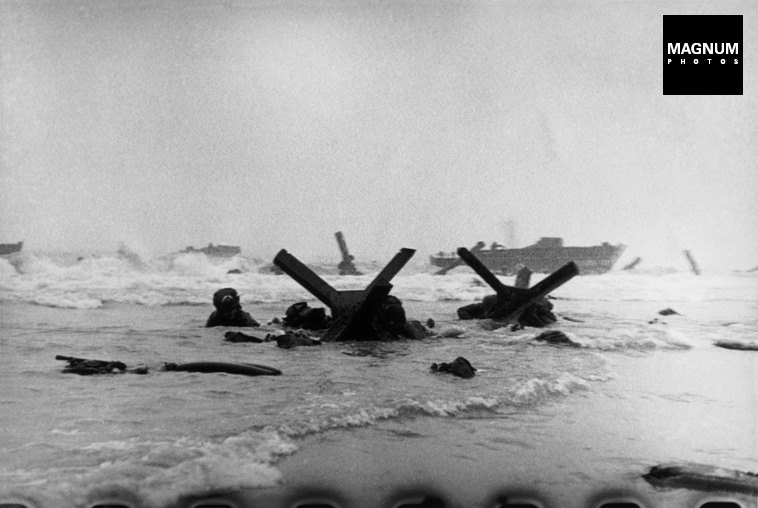
Robert Capa’s image of a soldier in the Normandy landings is gritty and full of movement blur but is shows a man in a desperate hurry, at risk if life. It also focuses the attention on his face and the determination shown by him. Other images, while fascinating and often actually giving more information about the event, such as this one, do not have the immediacy or drive shown in the most well-known image.
PAR121452_Social_Media_Watermark(1)

Images courtesy of Magnum Photos.

It is difficult to know whether this movement blur was deliberate, done as an accident or simply occurred in the processing, whichever one, it is very effective.

Hiroshi Sugimoto is a Japanese photographer who has experimented extensively with the use of time in his photography. He tends to work producing series of images. He says “the vision comes first……imagine the way I photograph the things…… bringing my camera into a movie theatre……I opened my shutter when the movie begins…… I leave my camera open……when the ending credit shows up I close my shutter…… the interior of the theatre shows in the white light coming out of the screen.     ……the people were in the theatre but they all disappeared…… the movie theatre…… holds the emptiness” (Sugimoto, 2009). The images are eerie and beautiful with the cinema walls illuminated by the light from the screen.

 Sugimoto has also taken a series of images concentrating on light. He found that when he was processing photographs he was plagued with random bouts of static which he calls ‘the demons in the darkroom’ (Sugimoto, 2011). He went on to deliberately generate static electricity and shoot the resultant flashes of light, man-made lightning. He then printed these images at an enormous size to form an exhibition which I was lucky enough to see in Edinburgh several years ago. The images are sharp white on a deep, velvety black, simple in appearance but they draw the eye in and you find yourself following the path of the discharge around the image.

Michael Wesely takes the concept of long duration photography to an extreme, photographing buildings being renovated, such as the Museum of Modern Art in New York, with the camera running for months or still life images of flowers slowly dying. The pictures of the buildings show layers and layers of lines as there is slow progress, they look somewhat like a pen and ink drawing of an artist’s conception of the building, but they appear more ‘real’ and obviously they are. Some of the images can be viewed at:

http://www.graphicine.com/unusually-long-exposure-photographs-by-michael-wesely/ (accessed 24/06/17)

http://itchyi.squarespace.com/thelatest/2010/7/20/the-longest-photographic-exposures-in-history.html (accessed 24/06/17).

Wesely says “”the lines in the sky put our existence, us, our planet into context with the Dance of the Universe, which coexists on an entirely different time scale [from us] …. The moment is fading, all that remains is the permanent overlapping of movements of all kinds, political or personal. The technologies of our times fuel this fire of restless ‘Online-Existence’. One day computers won’t have an on- or off-button anymore. We will always be online.” (Klenke, 2010).

A fascinating variant on this is when he takes long exposure, 5 minutes, images of people In the Museum of Modern Art, New York, looking at the even longer exposure images of the renovation works of the actual building. The people are visible, but look like ghosts.Other images are in colour, some are surprisingly delicate, others, mainly the flowers from ‘Stilleben’ are intensely coloured, almost violent, shocking given that they are showing the death of the flower..

 In the introduction to a recent book, Time Works, Harten describe these as ‘decidedly distinct traces of specific processes …… take on the form of a delicate, diaphanous mist …… like transparent gossamer made up of innumerable moments’ and also ‘what we experience in Michael Wesely’s photographs is the …… transitory visibility of the long since invisible’. (Wesely and Harten, 2010).This is the complete antithesis of the ‘decisive moment’. The images may appear dreamlike, often abstract, but are actually the opposite, time rules as absolute. Time held still.

An alternative view of time is used in the film Chungking Express where the opening scene uses a blurred movement to catch the attention of the viewer. This gives a sense of urgency to the film, and has drawn me in enough that I will watch the rest. The colours are intense, it is difficult at times to make out what you are seeing, and the scene feels immensely pressured, the opposite of the sense stillness captured by Wesely.

Francesca Woodman’s (1958-81) images are highly charged and often, but not always, personal.  Berger defines art as either private or public, but her work spans both, ‘intensely private photographs for public consumption……Woodman regularly appeared naked within the frame, her body contorted, her flesh blurred—at once visible and intangible. Each image feels viscerally revealing of something, or someone, beyond the frame—something public photographs can’t do.’ (Christoph, 2015). Her suicide, age 22, inevitably alters people’s perception of her work, partly by the simple fact that there is a limited oeuvre, not all of which has ever been published, but also because there is a temptation to read everything she has done in that context, rather than as early work of a woman who might, given the time, have gone on in a totally different direction.

Much of her work is monochrome, with stark tonal contrasts, showing images that are partially blurred, a jumping person in apparently derelict room ‘Untitled, Rome, 1977-78’, or showing only part of the person ‘Seven Cloudy Days, Rome 1977-78’. Other images use wildly contrasting juxtapositions of people and items such as in the Eel series, where a blurred person lies next to the sharply focused bowl of eels.

Badger says ‘she clearly sought to escape the strictures of the single image and still, frozen photographic stasis. And in her off-kilter compositions and constant roulades of wispy, swirling flight, she appears to hammer at the boundaries of the photographic frame itself’ and ‘Woodman’s oeuvre seems to have informed by the apparently inconsolable thought (for her) that society’s cards are irrevocably stacked against her sex. That no matter how hard she might try to escape constriction by gender, only in her art could she be free,’. (Badger, 2017. I wonder whether, if she had been working now, her work would have been less ‘constricted’ in this way bur equally how her view has led the way for the wide variety of female photographers today, many of whom take images of women and also how it feeds into the ongoing discussion about whether (or not) females perceive other females differently from male photographers and therefore make images that are fundamentally different. (Jansen, 2017).

In the context of thinking about the impact of blur on the emotional reading of the image it is clear that in Woodman’s work it is crucially important, in a similar way (although in a very different setting) to the Capa image on Normandy Beach. I find her images often disturbing, often beautiful, at times mesmerising and I am left wondering what she might have produced in an unknown future. She was born just after me, into a very different life, but I am unsure if I would have ever understood her and her thought processes.

References

Badger, G. (2017). Gerry Badger  Francesca Woodman. [online] Gerrybadger.com. Available at: http://www.gerrybadger.com/francesca-woodman/ [Accessed 30 Jun. 2017].

Christoph, S. (2015). FRANCESCA WOODMAN. [online] Brooklynrail.org. Available at: http://brooklynrail.org/2015/03/artseen/francesca-woodman-mar15 [Accessed 30 Jun. 2017].

JANSEN, C. (2017). GIRL ON GIRL. [S.l.]: LAURENCE KING PUBLISHING.

Klenke, S. (2010). The Longest Photographic Exposures in History – The Latest – itchy i. [online] Itchyi.squarespace.com. Available at: http://itchyi.squarespace.com/thelatest/2010/7/20/the-longest-photographic-exposures-in-history.html [Accessed 24 Jun. 2017].

Pro.magnumphotos.com. (2017). Magnum Photos. [online] Available at: http://pro.magnumphotos.com/C.aspx?VP3=SearchResult_VPage [Accessed 24 Jun. 2017].

Sugimoto, H. (2009). Contacts vol 2: Hiroshi Sugimoto. [online] YouTube. Available at: https://m.youtube.com/watch?v=mcbEgEv2kUw [Accessed 24 Jun. 2017].

Sugimoto, H. (2011). Hiroshi Sugimoto, Nature of light ; [Izu Photo Museum, Shizuoka, Japan ; October 26, 2009 – March 16, 2010]. Shizuoka, Japan: Izu Photo Museum.

Townsend, C. and Woodman, G. (2016). Francesca Woodman. London: Phaidon.

Wax, R. (2014). Unusually Long Exposure Photographs by Michael Wesely | Graphicine. [online] Graphicine.com. Available at: http://www.graphicine.com/unusually-long-exposure-photographs-by-michael-wesely/ [Accessed 24 Jun. 2017].

Wesely, M. and Harten, J. (2010). Time works. Munchen: Schirmer/Mosel.


Feedback on Assignment 2

Some thoughts and comments.

Blue text is my tutor’s comments, black my replies.

Demonstration of technical and Visual Skills, Quality of Outcome, Demonstration of Creativity

I like that you used your dog as a ‘hook’ to get the subjects to ‘sit’ for you. Everyone has their own method and this is obviously working for you.

The pictures themselves raised a couple of questions. Please remember there aren’t right or wrong answers to these, they are intended to prompt your thinking about your own work. They could form the basis of some useful learning log posts. o Why black and white? You state: “I decided to use a monochrome conversion for the final images as this bought a coherence to the series and evened out the variable backgrounds and lighting conditions.” In what way does black and white bring coherence? What does black and white do that colour might struggle with? What does it not do?

When I looked at the series of images they were very variable in lighting condition as all shot outside. I felt the colour images gave more prominence to the surroundings rather than the face itself, while the monochrome allowed the focus to be on the details of the person. There were also some distracting pieces of colour that I had not managed to avoid in the background as the people were shot were they stood and I did not ask them to move to a potentially better location. However, colour might have emphasised the skin tones of the people or helped to identify their ages.

All of your subjects are smiling and the pictures have the feel of a relaxed but professional portrait shoot. What do the portraits say about these ‘heads’ when shown as a series? Do the smiles affect how the work is viewed as a typology?

The ‘heads’ show a generally happy and content group of people who were prepared to have a ‘bit of fun’ while being photographed by a stranger. They were all taken while out on a walk in a park, so presumably in a relaxed moment. This gives a positive image – but if taken on another day, or in another place, these same people might be more subdued. I did show the images to the people and they were all pleased with how they looked! The smiles portray Scots as a positive group of people – not how they are usually perceived.

How did your choice of focal length and distance to subject affect how your sitter is portrayed? Related to this, how does camera position affect how we as viewers regard the sitter? Traditionally men and women were photographed differently in head shots, women looking up for a more flattering pose and men looking down to reflect power. What do your pictures do to challenge or support these stereotypes.

The images were all taken with me fairly close to the person, and often while I continued to chat to them, this did mean that they were all aware of the photo, no unexpected moments or expressions, therefore no surprises or glimpses of deep contemplation. I tried to take the images at a level with the person to get a feeling of equality. I had not considered differentiating between the pose of men and women, possibly this is showing that the previous stereotypes are less prevalent than in the past. I was not attempting to show power or beauty, but just the person as a person, with no emphasis on gender.

One thing I should point out is your captions. To be blunt, no one cares what camera settings you used. What they will care about though is something about your subjects. Their name perhaps, and where/when the portrait was made. Imagine you walk into a museum in 50 years and you see your portraits hanging on display. Are you interested in what camera settings were used or do you want to engage with the work and find out more about the people photographed? I’ve found a good test for whether pictures are working or not is to ask this question. If technical information is your first stop then the pictures are probably boring. If you want to learn more about the subjects and don’t care about technical considerations then the photographer has succeeded.

This is a very fair point. I only captioned the photos with camera settings because when I was doing TAOP some years ago this is what my tutor at that time wanted me to do. I would never look at technical information unless I was curious about how an image was achieved, and the image would have had to catch my attention first.

Overall I was pleased with the feedback and found it helpful. It has made me think harder about the ‘why’s’ of the images rather than the ‘how’.
Exercise 3.1

Brief: Using fast shutter speeds isolate a frozen moment in time.

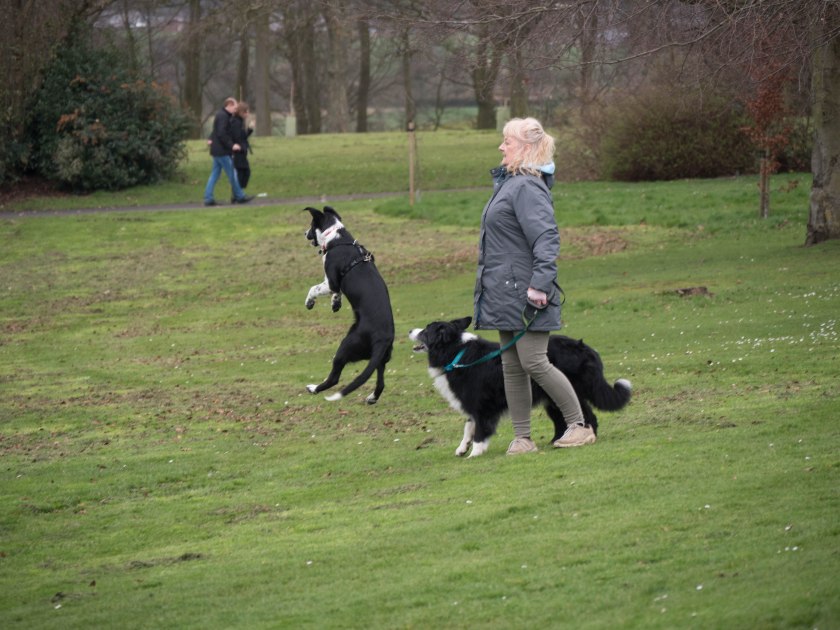
When I thought about this exercise I came up with several options such as capturing an animals’ movement e.g. a dog in mid leap or a bird in flight.

Leaping Dog

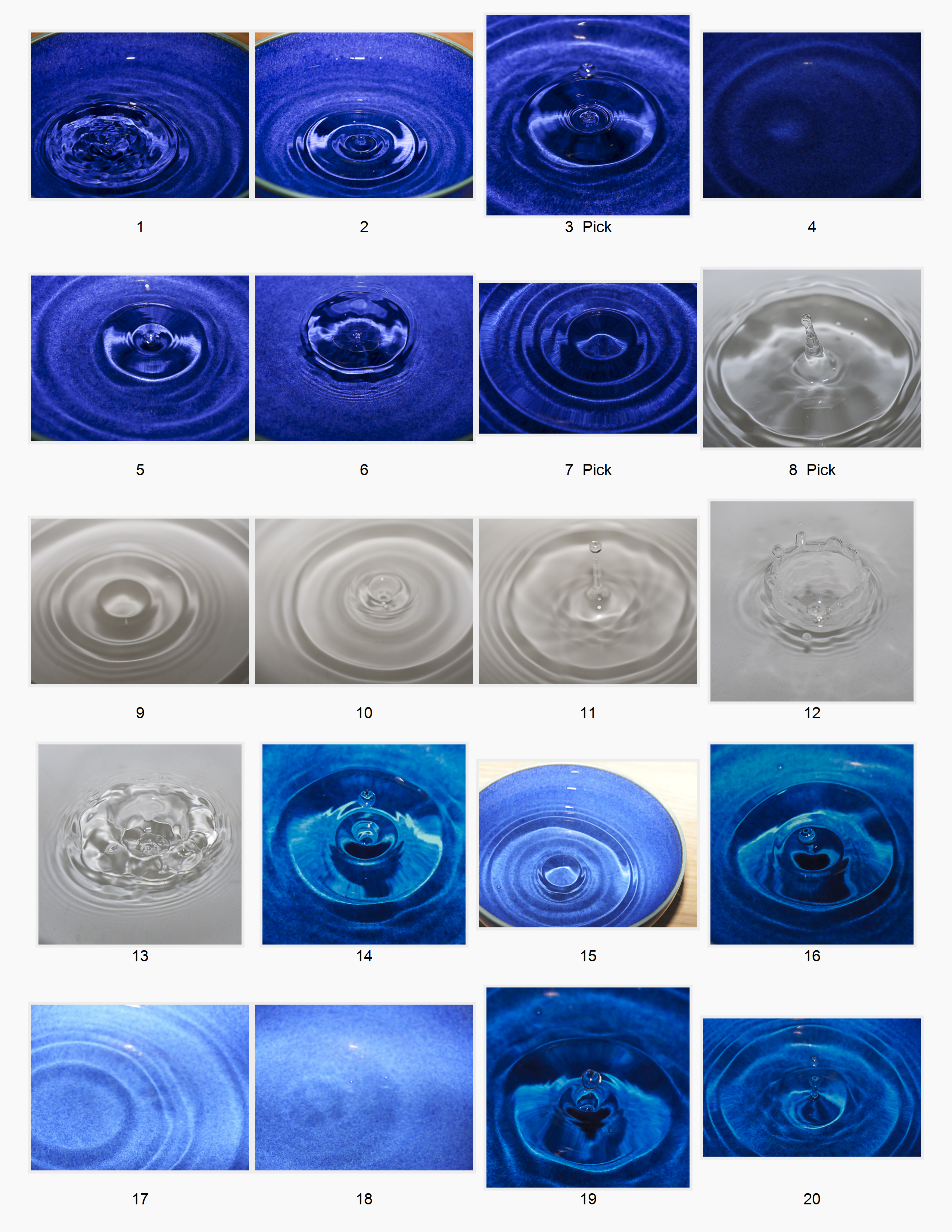
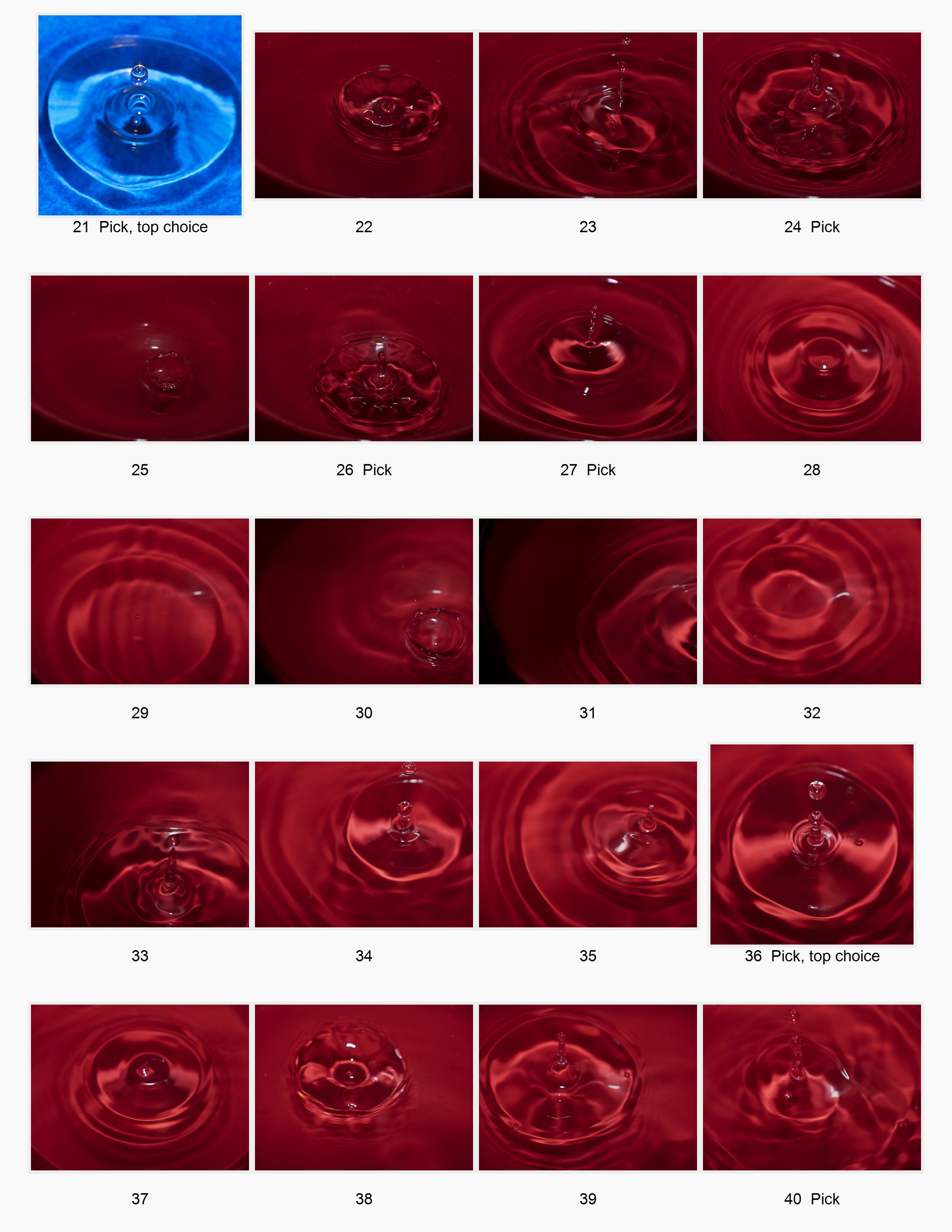
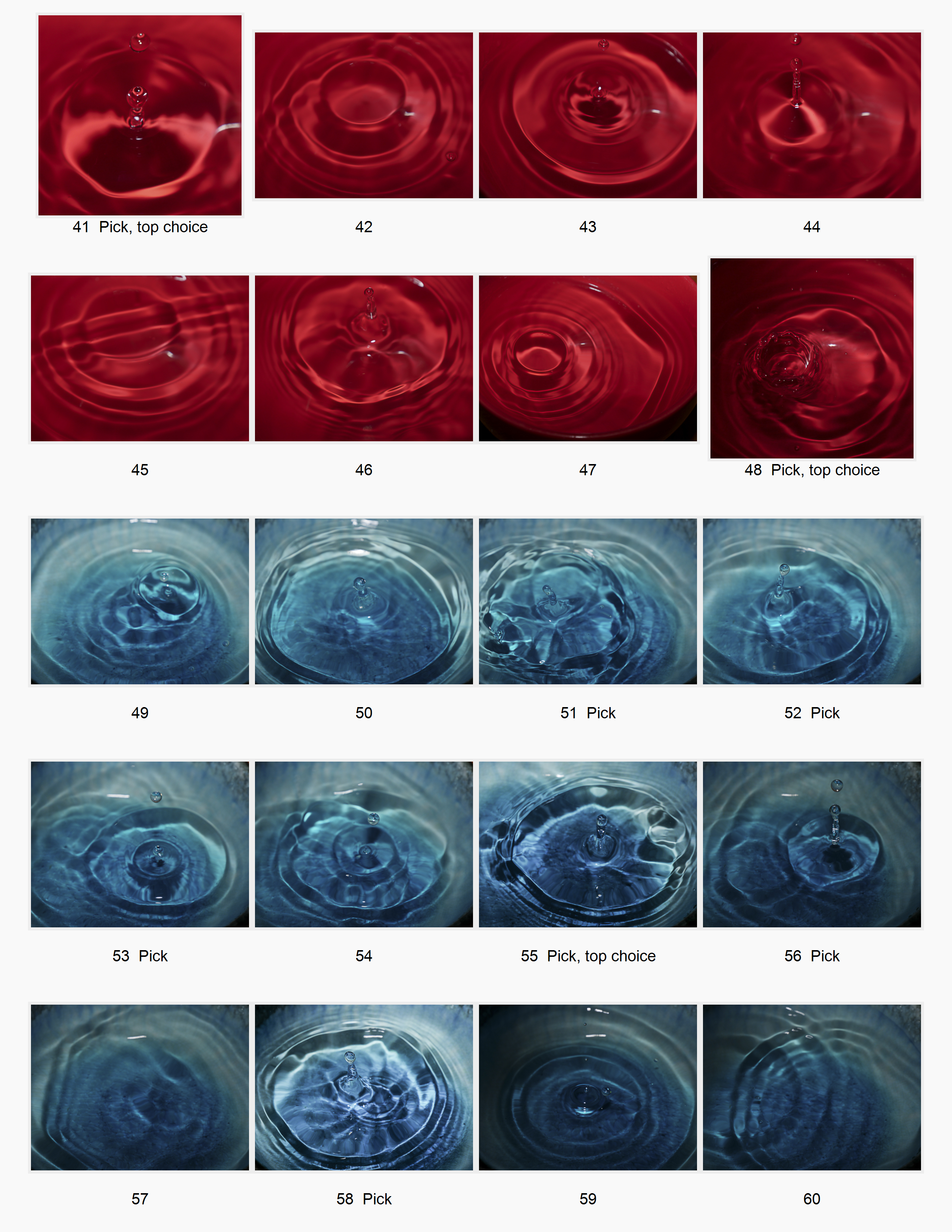
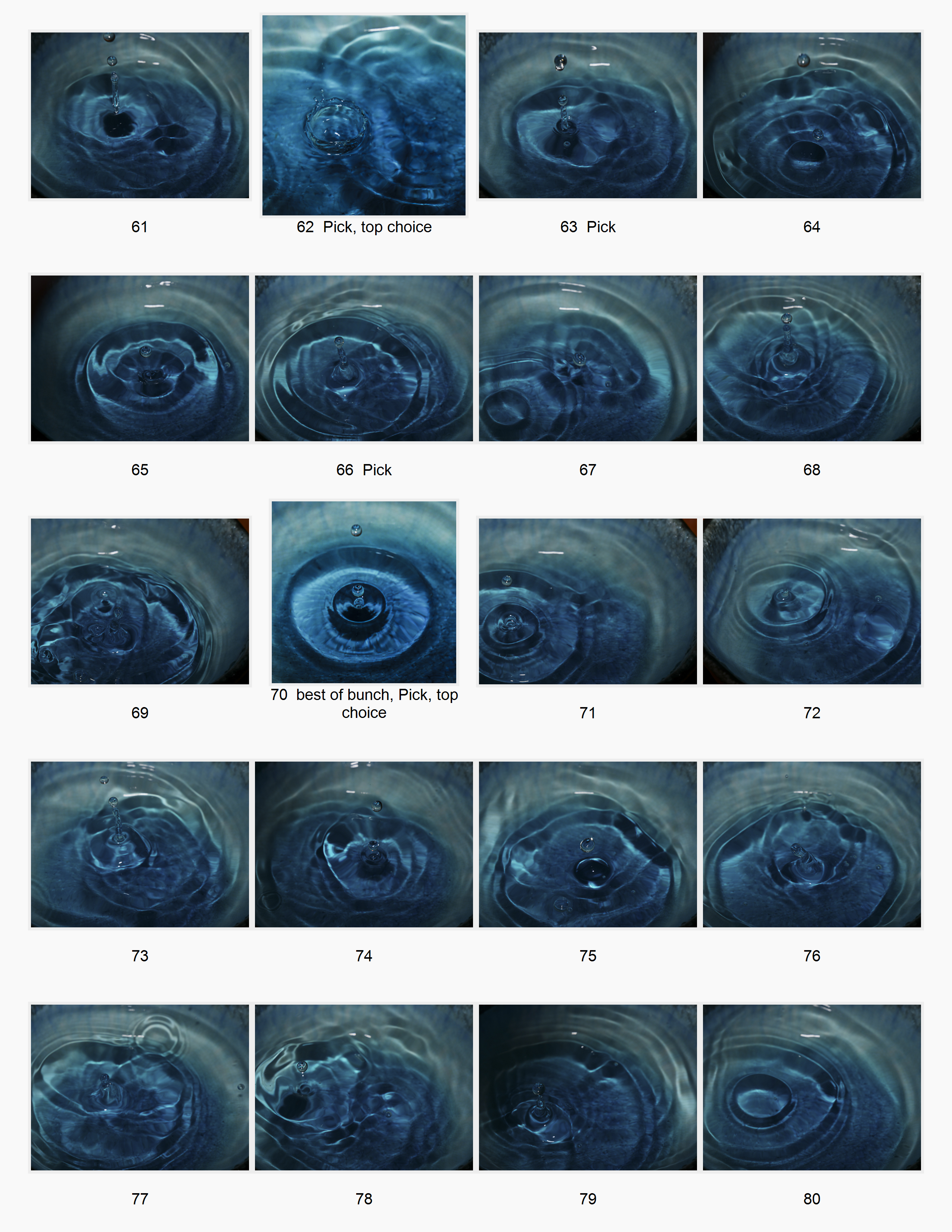
I then thought further and decided to have my own go at emulating the ‘milk drop’ photographs. I found this technically quite challenging. I set the camera to 1/8000 sec, and focused on the surface of water in a bowl. Initially I left the camera to set the aperture, which came out with the largest possible, but I found this cut down the depth of field too much so was not getting the images I was visualising, so changed to a fully manual mode with an aperture of f/9. I used my flash and a tripod to hold the image position stable. My assistant (my son) then slowly dipped water into a bowl while I tried to capture it landing. We had many failed attempts:

  • I mistimed the shot so just caught a ripple or just water
  • Using a white bowl was not very successful, as there was too much reflection from the flash and many of the images were burnt out completely
  • My flash takes longer than I realised to recharge, and needed to be watched to avoid a completely underexposed (black) frame.
  • There was reflection from a nearby window, so we had to move to a different room where I could cover the window

Eventually I got some images I was happy with. I have added contact sheets of a number of the images, marked with the ‘picks’, ‘top choices’ and the final preferred image.

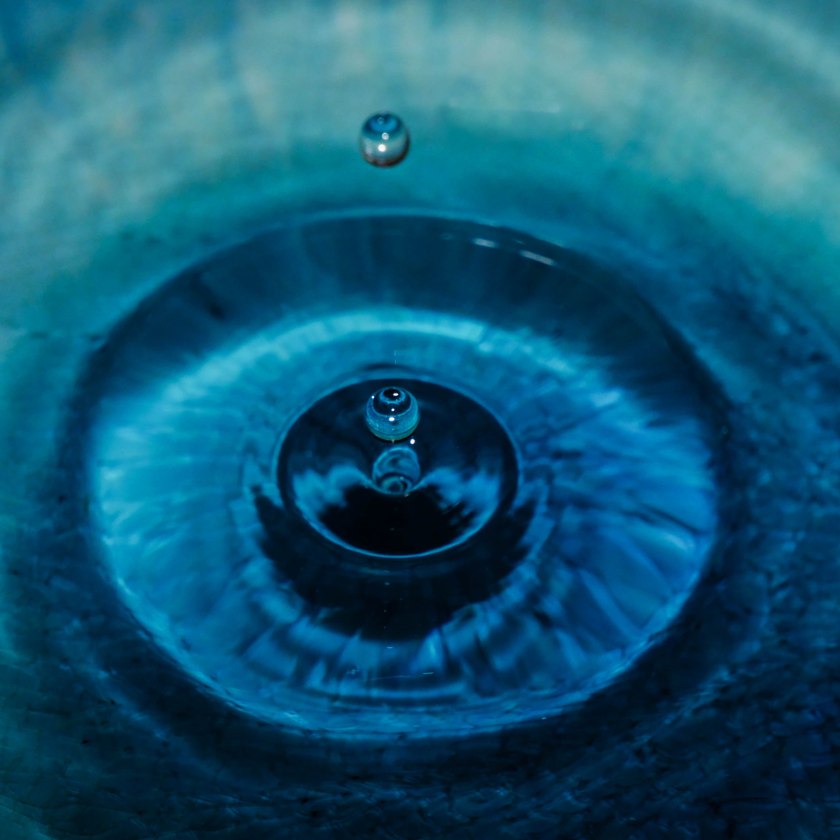
The final image that I chose was:

Frozen Moment

I felt the colours and pattern were interesting. I am aware that the higher drop is not totally sharp but felt it leads the eye to the drop that is just about to land. This was a fascinating exercise to carry out.